









Multiple episodes of repetitive vomiting in a 5-year-old boy
A 5-year-old boy with a history of asthma presented for a 1-year history of multiple episodes of emesis. What's the diagnosis?



The case
A 5-year-old boy with a history of asthma presented for a 1-year history of multiple episodes of emesis. The child’s first episode was at age 4, when he awoke and vomited 5 times. He also had an erythematous, pruritic rash on his arms and legs. Over the next 2 months, he had 2 additional episodes of vomiting with a rash occurring overnight. Two subsequent episodes of repetitive vomiting occurred in the evening without other symptoms. Another 2 episodes involved repetitive vomiting, a pruritic rash on the extremities, and diarrhea. A few episodes occurred within 30 to 45 minutes of brushing his teeth.
He had no associated fever, sick contacts, cough, headache, seizures, altered mental status, sore throat, or abdominal pain. Emesis was not bilious or bloody. Growth and development were normal. He had no history of gastroesophageal reflux. There was no preceding infection prior to these episodes. His asthma had been stable, without chronic coughing and without oral steroid use. The child had no history of anxiety or emotional disturbance. On further questioning, including a thorough history of food ingestions, all episodes occurred after exposure to mint.
Evaluation
On physical examination, he appeared well and in no acute distress. He was in the 50th percentile for height and weight. Blood pressure was 90/52. Lungs were clear to auscultation. There was no abdominal pain, guarding, or abdominal masses. He had no focal neurologic deficits. The child had a complete blood count with differential and comprehensive metabolic panel, which were unremarkable.


Click to zoom
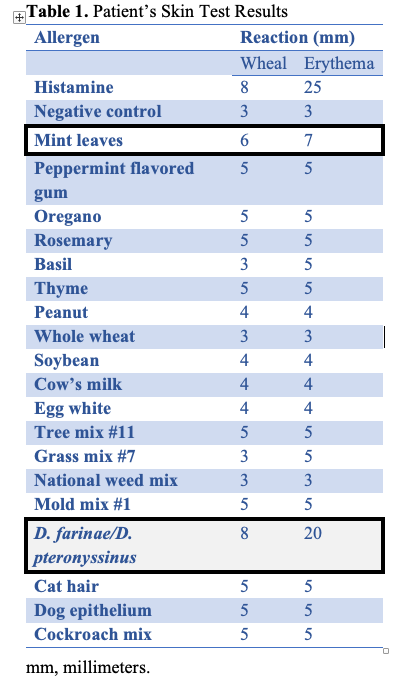
The child was referred to pediatric allergy and immunology for evaluation. A detailed food reaction history revealed that the child tolerated the top 9 food allergens in the US, including cow’s milk, egg whites, whole wheat, soybean, peanuts, tree nuts, fish, shellfish, and sesame (Table 1). He tolerated red meat on numerous occasions, even since these episodes commenced. He had no history of tick bites. His mother endorsed that all episodes occurred on days that the child had exposure to mint, and the child had no episodes on days he did not have mint. The exposures included chewing or swallowing a piece of mint-flavored chewing gum, ingesting chocolate mint candies or plain mint candies, or brushing his teeth with mint-flavored toothpaste. Reactions typically occurred 3 to 8 hours following ingestion of mint, or 30 to 45 minutes after brushing his teeth with mint-flavored toothpaste.
The patient’s symptoms of acute onset of cutaneous and persistent gastrointestinal symptoms were considered highly likely for anaphylaxis based on the World Allergy Organization’s revised anaphylaxis diagnostic criteria.1 Hence, an extensive allergy evaluation was performed.
The patient’s serum-specific immunoglobulin E (IgE) to mint, sage, basil, oregano, and thyme were less than 0.35 kU/L (Quest Diagnostics). Skin prick testing was performed for fresh mint leaves, peppermint gum (Wrigley’s 5 Cobalt peppermint flavor), fresh oregano, fresh rosemary, fresh basil, and fresh thyme. The patient was also tested with commercial extracts of the most common food and environmental allergens, including cow’s milk, egg whites, whole wheat, soybean, peanuts, tree mix No. 11, grass mix No. 7, national weed mix, mold mix No. 1, cat hair, dog epithelium, cockroach mix, Dermatophagoides pteronyssinus (D. pteronyssinus), and Dermatophagoides farinae (D. farinae) (Greer Laboratories). Five control subjects were skin tested to fresh mint leaf for comparison. A positive skin test was defined as a wheal at least 3 mm greater than the saline control. The patient had a positive skin test to fresh mint leaves and to standardized dust mite mix (Table 2). No control subjects reacted to fresh mint. The patient’s skin test to oregano, rosemary, basil, and thyme were negative.


Click to zoom
Management
The patient was advised to strictly avoid mint leaves and foods containing mint. A food allergy emergency action plan and epinephrine autoinjector were provided. With avoidance of mint, the child had no further reactions.
Discussion
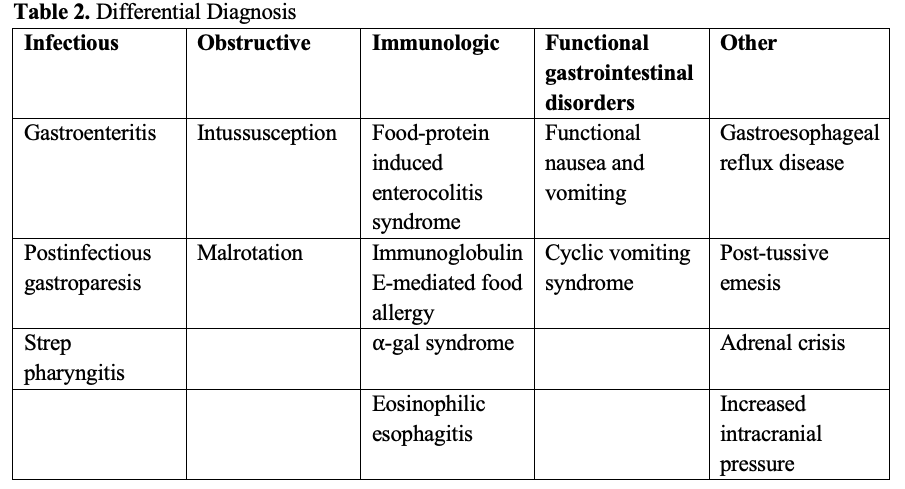
We report the first case of delayed IgE-mediated anaphylaxis to mint in a pediatric patient. IgE-mediated food allergy classically presents within minutes to 2 hours of ingestion. Interestingly, this patient’s anaphylaxis presented in a delayed fashion, typically 3 to 8 hours following ingestion. The most understood form of delayed IgE-mediated food allergy is the α-gal syndrome, manifesting as anaphylaxis 3 to 6 hours after ingesting mammalian meat (such as beef, pork, or lamb) due to an oligosaccharide antigen.2 Often, the onset of ⍺-gal syndrome follows tick bites and presents in individuals without a prior history of atopy (Table 2).
Also, in the differential diagnosis of delayed immunologic reactions to foods is food protein-induced enterocolitis syndrome (FPIES). FPIES is a non-IgE-mediated hypersensitivity to food that manifests with repetitive projectile vomiting beginning 1 to 4 hours after exposure to the food; it can also present with diarrhea 6 to 8 hours later.3 FPIES may result in significant dehydration, hypovolemia, and metabolic acidosis. FPIES typically presents in infancy, but late-onset symptoms can be seen.
The clinical presentation for FPIES varies based on the frequency of the antigen ingested. Acute FPIES is seen when an antigen is ingested on an intermittent basis. Typical features include acute onset of repetitive projectile vomiting starting 1 to 4 hours after ingestion, which can result in lethargy, hypothermia, and pallor; diarrhea may ensue within 6 to 8 hours. Between episodes, children thrive and are developmentally appropriate. Features of chronic FPIES are seen when a food is ingested on a regular basis, such as an infant drinking cow’s milk daily.
Chronic FPIES manifests with intermittent and progressively worsening vomiting, diarrhea, and failure to thrive. The top triggers for acute FPIES in children are rice, oat, cow’s milk, and soy, though numerous other foods have been reported.3 The top triggers for chronic FPIES in children include cow’s milk and soy.
Key distinguishing features between FPIES and IgE-mediated food allergy include delayed onset of symptoms in FPIES and the lack of typical allergic features, such as allergic skin or respiratory symptoms. Our patient presented with a pruritic rash with repetitive emesis and had a positive skin test to fresh mint leaves, supporting an IgE-mediated mechanism.
Mint is derived from the aromatic plant Mentha spicata, a member of the Lamiaceae family. Other plants in this family include oregano (Origanum vulgare), rosemary (Rosmarinus officinalis), basil (Ocimum basilicum) and thyme (Thymus vulgaris).
The essential oil extracted from Mentha spicata is commonly used in the cosmetic, pharmaceutical, and food industries. Most hypersensitivity reactions to mint are delayed type IV hypersensitivity, as classified by the Coombs and Gell scale, to mint toothpaste or teas.4 IgE-mediated reactions to mint or other members of the Lamiaceae family are unusual, and the majority of cases are among adults.4-8 Reactions were primarily from ingestion, though one case identified an asthma exacerbation from inhalation. One prior report identified a 13-year-old patient with immediate reactions to oregano and sage who had delayed angioedema following the ingestion of mint.9
Further characterization of the major antigens of mint and the Lamiaceae family would help in identifying cross-reactivity patterns and can lead to better understanding of why some patients’ reactions are delayed.9 Delayed anaphylaxis can be misdiagnosed given the challenges in identifying the trigger. This case brings awareness of the possibility of delayed IgE-mediated anaphylaxis beyond α-gal, as well as consideration of unexpected foods such as mint and others in the Lamiaceae family as potential allergens in the differential diagnosis for idiopathic anaphylaxis or delayed IgE-mediated anaphylaxis.
References:
- Cardona V, Ansotegui IJ, Ebisawa M, et al. World allergy organization anaphylaxis guidance 2020. World Allergy Organ J. 2020;13(10):100472. doi:10.1016/j.waojou.2020.100472
- Wilson JM, Platts-Mills TAE. α-gal and other recent findings that have informed our understanding of anaphylaxis. Ann Allergy Asthma Immunol. 2020;124(2):135-142. doi:10.1016/j.anai.2019.11.024
- Nowak-Wegrzyn A, Berin MC, Mehr S. Food protein-induced enterocolitis syndrome. J Allergy Clin Immunol Pract. 2020;8(1):24-35. doi:10.1016/j.jaip.2019.08.020
- Damiani E, Aloia AM, Priore MG, et al. Allergy to mint (Mentha spicata). J Investig Allergol Clin Immunol. 2012;22(4):309-310.
- Bayat R, Borici-Mazi R. A case of anaphylaxis to peppermint. Allergy Asthma Clin Immunol. 2014;10(1):6. doi:10.1186/1710-1492-10-6
- Paiva M, Piedade S, Gaspar A. Toothpaste-induced anaphylaxis caused by mint (Mentha) allergy. Allergy. 2010;65(9):1201-1202. doi:10.1111/j.1398-9995.2010.02329.x
- Szema AM, Barnett T. Allergic reaction to mint leads to asthma. Allergy Rhinol (Providence). 2011;2(1):43-45. doi:10.2500/ar.2011.2.0008
- Vartholomaios S, Pitsios C, Mikos N, Kompoti E, Kouridakis IS. Allergy to basil, a Lamiaceae herb. J Investig Allergol Clin Immunol. 2007;17(5):348-349.
- Yazıcı S, Nacaroglu HT, Bahçeci Erdem S, Karaman S, Can D. Angioedema due to Lamiaceae allergy. Iran J Allergy Asthma Immunol. 2018;17(1):97-99.
Newsletter
Access practical, evidence-based guidance to support better care for our youngest patients. Join our email list for the latest clinical updates.









Full case: Infant presents with an asymptomatic pearl-like nodule on the heel
Infant is closely monitored at subsequent well visits and rechecked after 3 months, showed full resolution of the skin lesion over the heel area.
Diagnose this infant with an asymptomatic pearl-like nodule on the heel
Can you diagnose this patient? Take our poll and find out! Then check back for the full case, differential diagnosis, and correct diagnosis.

