

A 3-year-old boy presented with a pruritic perianal rash, rectal pain, and constipation of 3 weeks' duration. The child had initially been treated for pinworms by one of his caregivers.
A 3-year-old boy presented with a pruritic perianal rash, rectal pain, and constipation of 3 weeks' duration. The child had initially been treated for pinworms by one of his caregivers.
In the aftermath of Hurricane Katrina's devastation in the Gulf Coast region, it is important for physicians in the United States to consider the infectious disease risks for children who have been displaced or who are still living in affected areas. These risks include infections acquired through ingestion of waterborne organisms; wound infections; lack of immunization continuity; and overcrowding, which increases the risk of respiratory or GI infections. In addition, problems will arise from disruption of therapy for select populations of children, such as those who are HIV-infected; those receiving immunosuppressive treatment; and those in need of continuous antibiotic prophylaxis, such as those who have sickle cell disease.
This black lesion had been present on the upper back of a 5-year-old girl since her birth. The lesion had gradually enlarged to its current size of 1.5 cm. In the past year, 3 satellite black macules had developed in the surrounding area.
This adolescent girl presents with painful purple papules that have developed on her toes. These papules are making it impossible for her to wear her "fashion" shoes to school in the late fall and early winter. She reports that her feet have been cold for as long as she can remember and that she is not bothered by it. She is otherwise healthy, takes no medications, and does not smoke.
This 12-month-old girl presented with a diffuse rash that was first noticed by the child's day-care provider a day earlier. A fever (temperature of 39.4°C [103°F]) subsequently developed.
Your patient is a 14-year-old boy who complains of bilateral foot pain of several weeks' duration. Sometimes, he tells you, the pain is so bad that he cannot bear weight and has to crawl from place to place. As you talk with him, you note that all 10 fingernails are abnormally thick and raised.
In a recent survey by the American Counseling Association (ACA), eight in 10 adolescent girls said that acne makes them feel embarrassed, unhappy, or less attractive. The survey, underwritten by Dermik Laboratories, polled 738 girls between 13 and 17 years old. Its goal was to raise public awareness of the impact of acne during important moments in a teenager's life.
What's Wrong With This Picture? Child With Appendicitis-like Symptoms
A 16-year-old girl presented with a painful rash on her hands and feet, and a sore throat. The rash, which "itched and burned," had appeared on her palms and soles a day earlier and had worsened overnight.
Some studies suggest that orally administered dapsone is effective for infections caused by spider bites (eg, brown recluse spiders) in dosages of 4 mg/kg/d for 3 days. Can dapsone be used in children and, if so, at what dosage?
While spending a month in Cuba, my travel companion experienced seabather's eruption (Figure), which was described by Drs Mary Sy and Gary Williams in their Photo Essay "The Dermatologic Perils of Swimming" (CONSULTANT FOR PEDIATRICIANS, July/August 2004, page 333). Fortunately, some Cuban onlookers knew how to treat this condition (referred to locally as "El Caribe"). After vinegar was applied to the eruption, the pruritus and burning diminished almost immediately.
During a neurologic evaluation for seizures, a 17-year-old boy with epilepsy was noted to have a deformity of both lower eyelids. According to the boy's mother, the deformity had been present since birth; it was not related to the patient's neurologic condition.
This 10-year-old girl presents with a 2-week history of a persistent rash around the lips.
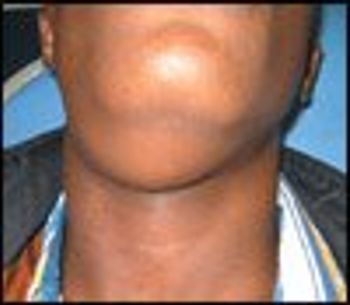
14-Year-old boy who presents to emergency department with nonpainful swelling under his chin that began about a week earlier. Swelling has been gradually growing; patient now has some difficulty in flexing his neck.
The Food and Drug Administration (FDA) last week approved a topical acne gel developed and manufactured by the Canadian drug company QLT Inc. for use for patients between 12 and 17 years old.
Children and adolescents who have had a malignancy are at risk of medical, psychological, and social late effects of their disease and its treatment. If you're aware of potential problems and how to screen for them, you can help ensure the good health and proper development of these vulnerable youngsters.
A 2-year-old girl has a pimple-like swelling on her right middle finger that has expressed green fluid and developed erythema.
Each of the 21 photographs on the following 4 pages was featured in Dermclinic during the past year. How many of these disorders do you recall?
This 13-year-old boy has a Becker nevus--also called Becker melanosis, because the lesions do not contain nevus cells. This common lesion is characterized by the abrupt onset of hyperpigmentation that gradually expands; it appears at or before adolescence.
The parents of this 2-year-old boy brought their son for evaluation of swelling of the right leg and excoriation and serosanguineous discharge from the ankle region of 3 days' duration.The child had had a hemangioma of the right ankle since birth. Subsequently, there was gradual spread of the lesion along the leg to the buttocks.
ABSTRACT: Children are at greater risk than adults for many travel-related problems, such as barotitis and barotrauma associated with flying, cold and heat injury, drowning, and infection with geohelminths. Most of these problems can be avoided with appropriate measures. To prevent insect-borne diseases, advise parents to apply permethrin to their children's clothing before the trip and apply slow-release DEET (30% to 35% concentration) to their skin every 24 hours. Infection with ground-dwelling parasites can be avoided by wearing protective footwear. At high altitudes, infants and children may experience acute mountain sickness. Acetozolamide (5 mg/kg/d, divided bid or tid) is an effective prophylactic; however, it is contraindicated in patients with sulfa allergy. Some preventive measures that are effective in adults may not be appropriate for children; for example, several medications used to control motion sickness are ineffective and associated with significant side effects in children.
After spending a day at the beach, a 12-year-old boy presented with a second-degree sunburn and blisters on his shoulders (A). According to his mother, he had used sunscreen. The child was not taking any medications. Except for a significant number of moles, his skin was normal.
Consultations & Comments: Do You Recognize This Lesion?
This 14-year-old girl had first noticed the well-circumscribed, roughened, irregular growth on her right middle finger 6 months earlier. The lesion had progressively enlarged. The girl's mother had a similar, but smaller, lesion on the left elbow. Alexander K. C. Leung, MD, and Justine H. S. Fong, MD, of Calgary, Alberta, diagnosed verruca vulgaris. This proliferative, hyperkeratotic, exophytic lesion is most commonly caused by human papillomavirus types 2 and 4.
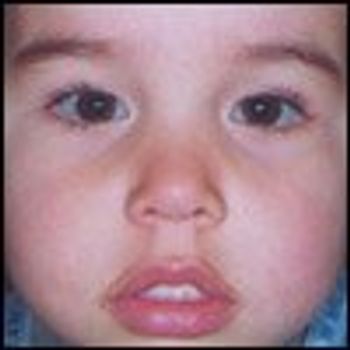
A 3-year-old boy who presents with blue sclerae and a history of tibial fracture following a minor trau- ma (jump from a height of less than 18 inches). Has a long-standing complaint of back pain. Mother remarks that the boy bruises easily. Medical history otherwise unremarkable.