

What's causing this newborn's feeding problems?
What's causing this newborn's feeding problems?
A 3-year-old girl develops a red, dry, flaky rash over her body, and a dried, yellow crust around her eyes. What's the diagnosis?
Right lower leg pain prompted a 15-year-old boy to seek medical attention. An hour earlier, he had fallen on the leg during a football game and on standing had heard a "pop." No gross abnormality was noted. Jack-Ky Wang, MD, and Laurie Meng, PA-C, of Palos Heights, Ill, report that radiographs revealed a transversing pathologic fracture through an expansile lytic lesion of the right fibula.
Chest pain in children evokes anxiety in patients and their parents--and prompts frequent visits to the pediatrician's office, urgent care facility, or emergency department (ED). In a prospective study, Selbst and colleagues reported that chest pain accounted for 6 in 1000 visits to an urban pediatric ED.
Musculoskeletal infections in children encompass a broad spectrum of entities that vary greatly in severity and complexity. Their presentation ranges from obvious and acute to insidious and chronic.
For several months, a 12-year-old boy has been bothered by intermittent pruritus of the feet. He is very active in sports all year, and his feet tend to perspire heavily. He has a family history of seasonal allergies. He says that the rash worsened after he used an over-the-counter hydrocortisone cream.
A 6-month-old infant was brought for evaluation of an "atypical mole" on the chest that her parents and referring physician feared might be skin cancer. The parents reported that the lesion had been present since shortly after birth and had become red and inflamed after minor trauma on a few occasions and once had blistered.
Attention deficit hyperactivity disorder (ADHD) is very common. In the United States, between 6% and 10% of children and adolescents are affected, as are 4% of adults.1 Children in other countries also have ADHD, although rates of comorbid disorders may vary from those found in the United States.2
An 8-year-old boy was brought to the emergency department with fever, bloody and mucous diarrhea, and abdominal pain. Specimens for stool culture were sent to the laboratory, and therapy with trimethoprim/sulfamethoxazole (TMP/SMX) was initiated.
A 12-year-old boy from Pakistan presented with weakness, night sweats, anorexia, and chronic cough of 2 months' duration. He had undergone spinal surgery about 5 months before immigrating to the United States when acute paralysis, kyphosis, and a prominent midline hump (gibbus deformity) developed in his thoracic spine. The child appeared pale and weak but in no acute respiratory distress. His weight was 20.5 kg (45 lb). He had difficulty in walking without assistance. Muscle wasting was noted in the arms and legs, and he had a healing lesion on the left elbow that drained pus. Other physical examination findings were unremarkable except for a fever (temperature of 37.2°C [99°F]) and the gibbus deformity.
This 18-year-old girl had been taking divalproex for seizure disorder for 2 years. Because she had gained weight while taking this medication, the patient asked for another drug. Her neurologist prescribed lamotrigine. Ten days after starting the new agent, a generalized, painful, pruritic, ery- thematous dermatitis; fever; and sore throat developed.
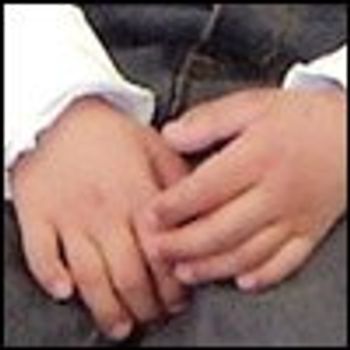
Six-year-old East Indian boy delivered by normal spontaneous vaginal delivery to a para 3, gravida 2, 42-year-old mother following uncomplicated, full-term pregnancy. Apgar scores: 9 and 9, at 1 and 5 minutes, respectively. Birth weight, 2.5 kg. Infant hypotonic at birth with numerous dysmorphic features. Delayed developmental milestones; IQ measured at 80.
During a routine physical examination, a 3-year-old boy was noted to have speech delay and hyperactive behavior. The child was born at term to a 25-year-old mother with epilepsy, which was managed with phenytoin. His birth weight was 3.5 kg (7.8 lb); he had no neonatal problems or features of fetal Dilantin syndrome. However, he had undergone bilateral hydrocele and inguinal hernia repair and tube placement for recurrent ear infections. His half sister (from his mother's previous marriage) needs help in reading and math. His father is healthy.
Child Protective Services (CPS) has asked you to evaluate a 6-month-old girl with a genital mass. The goal is to determine whether the "weird lump in the baby's private area"--noted while the child's diapers were being changed in day care--was the result of sexual abuse.
Fourteen-year-old JT is worried. During health class last week, he learned about the different sexually transmitted infections as well as about testicular self-examination. While practicing his monthly testicular examination in the shower, he noticed that he had a number of small growths on his penis. On further questioning, JT insists that he has never been sexually active with another person.
A 12-year-old African American boy presented to the emergency department with a painless swelling on the left side of his head that had gradually progressed over a month. There was no history of pain, trauma, or fever. Findings from a review of all other systems were normal.
Medicine is at least as much art as science. Often things are not clear-cut, but rather appear in shades of gray. We offer the following list of terminology for those who don't mind thinking in terms of black or white.
A healthy, 3-year-old African-American girl is brought to your office for evaluation of hair loss. The child does not have a history of recent infection or medication use. She has not had any hair styling treatments and has not been subject to trauma or application of heat to the hair. What's the diagnosis?
Your doctor has just told you that you have an infection with human papillomavirus (HPV). Most teens have a lot of questions about warts and HPV. This guide will help answer some of those questions.
A 5-year-old girl is brought for evaluation of an asymptomatic inflamed streak on one leg that has been present for several weeks. She is otherwise healthy and takes no medications.
Several asymptomatic, erythematous papules and plaques had appeared on the hands of an otherwise healthy 11-year-old girl. The personal and family medical histories were noncontributory. A punch biopsy from the largest lesion on the palm confirmed the clinical diagnosis of localized granuloma annulare, a self-limited inflammation of the dermis
The "A" in the title stands for acrodermatitis enteropathica, an uncommon underlying cause of diaper dermatitis (DD). The "Pee," the colloquial term for urine, is probably the most common irritant (along with feces) that contributes to the breakdown of skin in the diaper area.
The prevalence and incidence of sinus infection, or sinusitis, is increasing and has been estimated to affect 31 million persons in the United States each year. It is one of the most common reasons why patients seek a physician's care. If left untreated, sinusitis can cause significant physical symptoms and can negatively affect quality of life by substantially impairing the daily functioning of sufferers. For children, this can mean learning difficulties at school and for adults, a loss of efficiency at work.