

Dermatology
Latest News
Advertisement
Advertisement
Once Thanksgiving 2003 passed, Congress grew anxious to adjourn; members prefer to spend the Christmas season at home, with family and constituents.
Pediatricians increasingly are recognizing a mandate to treat pain aggressively. Psychotropic drugs have new pediatric uses, broadening clinicians' options.
A 22-month-old boy is brought to you with an asymptomatic, linear scaly rash that developed on his right elbow four months ago. Two weeks after onset, the eruption had extended down his right arm to the top of the hand and onto the fourth finger.
Pediatricians increasingly are recognizing a mandate to treat pain aggressively. Psychotropic drugs have new pediatric uses, broadening clinicians' options.
The physical examination for a patient seeking clearance to participate in a sport should focus on areas likely to yield significant findings--notably, the cardiovascular and musculoskeletal systems.
Proper measurement of blood pressure is essential both to detect children with hypertension and to avoid over-diagnosis. Once the condition is identified, the pediatrician must decide whether the patient requires lifestyle changes alone or antihypertensive drug treatment as well.
Q Now that summer is here, I get calls from parents asking how to keep their children from constantly scratching itchy rashes that occur during the warmer months.
The author reviews the presentation, diagnosis, and treatment of a handful (and they are a handful!) of dermatologic complaints: eczema, diaper rash, scabies, lice, and alopecia areata.
Something's "going around": Skin creases on a baby's limbs (Michelin tire baby syndrome, or congenital diffuse lipomatosis)
It isn't just about skin: Atopic dermatitis affects a child's psyche. To keep the disease under control, prescribe sufficient topical corticosteroids and administer a generous dosage of reassurance.
The authors take a case-based look at 10 immune disorders, and review when to suspect a primary immunodeficiency in a child with frequent infections and how to confirm the diagnosis.
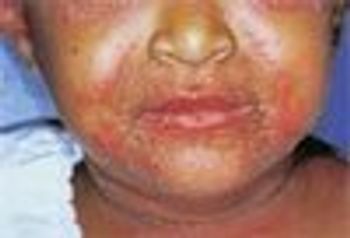
A toddler was brought to the emergency department with a 3-day history of a rash on her neck and irritability and fever (temperature, 38.3°C [101°F]) of 1 day's duration. The child's mother noticed a red, purulent bump on the girl's hand 2 days before the rash developed.
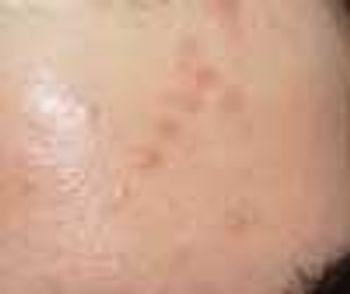
After several days of suffering fever, headache, and malaise, a 17-year-old boy noticed a rash developing over much of his body. He sought medical attention and was admitted to the hospital.
A physician who practiced amid an outbreak of smallpox reviews the immunization procedure and complications.
A physician who practiced amid an outbreak of smallpox reviews the immunization procedure and complications.
Smallpox has re-emerged--not yet as a disease but as a subject of apprehension, debate, and misunderstanding. Here, an expert reviews the disease, vaccine, and proposed immunization strategies.
A 14-year-old girl is brought to you complaining of an itchy red rash on her back. The rash appeared four months ago as a scaly red bump and enlarged over several weeks in an annular pattern to cover a large area.
You are asked to evaluate an 8-year-old boy who recently developed white rings around moles on his neck and back. Although he complains of slight itching, you don't see signs of scratching.
All cutaneous and mucosal surfaces can fall prey to fungi such as dermatophytes and yeasts. Here's how to recognize superficial fungal infections and initiate treatment.
The preparticipation examination of these young athletes must address some important concerns beyond those of the usual PPE.
Advertisement
Advertisement
Trending on Contemporary Pediatrics
1
Menstrual irregularities in adolescents: When to investigate
2
FDA proposes cadmium action levels for baby food under Closer to Zero
3
Family-focused behavioral care tied to better HbA1c in pediatric T1D
4
Managing infection risks in children on biologic therapies
5