
Consultant for Pediatricians Vol 4 No 4

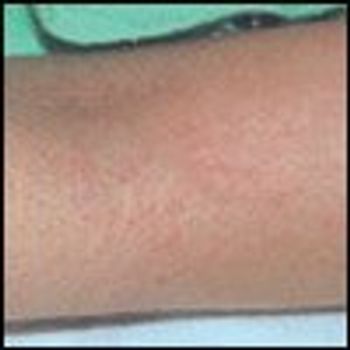
THE CASE: A 3-year-old boy is brought to the office by his mother. The previous evening, she had noticed a single large red spot on the back of his thigh. This morning, his whole body was covered with a similar rash, and he had a temperature of 38.8°C (102°F). The mother administered 1 dose of acetaminophen at home for the fever; the rash was asymptomatic.
This 5-year-old girl with multiple congenital abnormalities presented for a routine checkup. She was born with Apert syndrome, also known as acrocephalosyndactyly.A peaked head, sloping eyes, and "mitten hands" are typical features.

A 16-year-old boy is concerned that his right index finger looks "odd." The finger is several centimeters longer than his left index finger, and it is also wider. The boy's mother reported that the finger had always seemed to be a little larger than the others, even when the patient was an infant, but no one paid it much attention.

A 9-week-old Caucasian infant is brought to the primary care physician for evaluation of purpura and petechiae. His parents noted the bruising the previous night, which grew progressively worse throughout the next day. The lesions seemed to appear "out of the blue" without apparent cause, including trauma.

An 8-year-old boy seen at a gastroenterology clinic after "accidentally" swallowing 2 coins 4 days earlier. Had difficulty in breathing shortly after swallowing the coins and was taken to emergency department. X-ray films at that time demonstrated coins in his esophagus. Patient was immediately transferred to a tertiary care facility. Repeated x-rays showed the coins in his stomach. Patient was sent home with instructions to follow up with his pediatrician in 1 to 2 days.