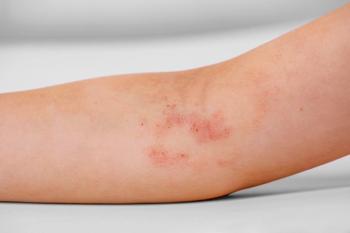
Real-world claims show dupilumab was tied to a 33%-52% lower risk of atopic march progression vs systemic corticosteroids in children with AD.
The INTEGUMENT-OLE study results highlight the long-term efficacy and safety of roflumilast cream for pediatric patients with atopic dermatitis.
In a recent interview with Contemporary Pediatrics, Lawrence Eichenfield, MD, discussed the INTEGUMENT-OLE study, a 56-week, open-label extension investigating roflumilast cream 0.05% for atopic dermatitis (AD) in children aged 2 to 5 years.
This study followed initial 4-week pivotal trials to provide critical long-term data on a novel, nonsteroidal, once-daily topical therapy. Eichenfield emphasized that while the initial 4-week study demonstrated rapid efficacy, the extension study revealed that improvements continued to climb rather than plateau.
As a PDE4 inhibitor, roflumilast’s anti-inflammatory mechanism not only addresses active rashes but also improves the skin barrier and reduces itch. A significant highlight was the study’s proactive dosing regimen: Patients who achieved “clear” skin were transitioned to a twice-weekly maintenance application. This approach provided excellent long-term disease control, a vital tool for a population where continuous topical corticosteroid use is restricted because of safety concerns.
Safety is paramount when treating toddlers and preschoolers because of their high body surface area–to-weight ratio. Eichenfield noted that roflumilast demonstrated an exceptional tolerability profile: Over 97% of participants showed no evidence of local irritation across 56 weeks. Reports of stinging or burning remained below 1.8% at any given time point.
Regarding systemic safety, the adverse events reported—such as upper respiratory infections, nasopharyngitis, and fever—were consistent with the typical health incidents expected in the lives of children aged 2 to 5 years over a year-long period, rather than being drug related. These data give clinicians significant confidence in the drug’s safety for chronic management.
Historically, treatment options for this age group have been limited, often leading to “steroid phobia” among parents. Eichenfield concluded that roflumilast fits into the management landscape as a highly tolerable, “as-needed” or proactive therapy. By providing a reliable nonsteroidal option that minimizes itch and sleep disturbance, the treatment significantly improves the quality of life for both the pediatric patients and their families.
Contemporary Pediatrics:
I wanted to ask you today a little bit about the INTEGUMENT-OLE study. It followed children for 56 weeks, well beyond the initial 4-week pivotal trial. What did the long-term data reveal that the shorter study couldn’t?
Eichenfield:
First of all, by background, I think it’s important to recognize that this is a study of a novel, nonsteroid anti-inflammatory for atopic dermatitis. It had been studied, as you pointed out, in that 4-week time period, once a day over 4 weeks. And it was nice that they could do it in a short period of time and show the difference from the vehicle and show efficacy. But one of the clinical needs, one of the things we want to be able to do, is to have topical therapies, which we’re not running from, where with topical steroids, you’re limited. You can’t do continuous topical corticosteroid use, or even if it’s intermittent, you’re figuring out what the is quantity, or you’re overusing it. So here we have roflumilast cream 0.05% geared in this very young age group of 2- to 5-year-olds who generally have very high body surface area disease. Even some of the mild patients can have a fair amount of body surface area involvement, and a 4-week time period is a really short time period to look at adverse events, and then so the open-label extension study is a way for us to get a longer observation time period in patients who all had access to the drug. They’re all on the roflumilast 0.05% and the study’s design is typical with patients using the medicine and using it as needed, with an assessment of the safety, but also looking at efficacy. But also novel in this study was that if patients made it to being totally clear, they were put on a proactive regimen of once-a-day application twice a week. So that’s sort of a novel way of treating people with some very interesting data about how well those patients did with their long-term disease control.
Contemporary Pediatrics:
I noted that one of the more striking findings was that efficacy continued over time, rather than plateaued. What do you think that trajectory tells us about the mechanism of roflumilast cream in this population?
Eichenfield:
As a PDE4 inhibitor, it’s anti-inflammatory. So in a 4-week time period, they showed differentiation from vehicle. But the point is that not everyone was clear at that point or and the levels of relative clearness that they got increased over time in the open-label extension. Also, there were some patients were on vehicle who then rolled over, and they caught up pretty quickly. But what it’s showing is that I think both individuals can get clearer over time, and the population response of those who have make it to clearer, almost clear, or easy, you have 75% improvement. Or those who make it to the different itch scores increases over time because of the continued anti-inflammatory effect, which doesn’t just impact inflammation; it also improves the skin barrier and decreases the itch. It's sort of de-amplifying what’s normally this combination of factors that make the itchy rashes of eczema so annoying to, patients and families,
Contemporary Pediatrics:
How would you characterize the tolerability profile from this study, and does it give you confidence in prescribing a drug like this?
Eichenfield:
When it comes to topicals, we looked at tolerability, and then we look at safety. And the tolerability is like, does it sting or burn, or are there other problems that sort of limit its use? And that was clearly a focus of the study, because not only was it looked at in terms of the relationship to what percentage of patients had tolerability issues, and this particular extension study was greater than 97% of the patients had no evidence of local irritation across the time points. But they also asked the caretakers about reports of stinging or burning at each visit, and it was less than 1.8% of participants at any time point who over that 56-week time period had problems with tolerability and the safety aspects really sort of like, “Oh, is there some issue with accumulated use over time, which is going to create problems with immunosuppression or any particular side effect profile?” And so, looking at the treatment of urgent adverse events, most of the stuff that was seen in. It at a significant rate of 4% or greater, is stuff that you’d expect to happen in the lives of 2- to 5-year-olds over 1 year, and not necessarily from a drug. So 8.7% had upper respiratory infections. There was a little bit of nasal pharyngitis, a little bit of fever. It doesn’t mean it’s from a drug, but it’s during that time course, a few [gastrointestinal] side effects as well as a very low rate of serious adverse events, especially those attributed to the drug. I think the safety was really tantamount from that study, as well as the tolerance, as you queried about.
Contemporary Pediatrics:
Historically, options for toddlers and preschoolers with AD have been quite limited. In your view, how does this drug now fit within the overall management landscape, and are there any gaps that sort of remain?
Eichenfield:
First of all, we’re looking at 2- to 5-year-olds. There’s other data down the road looking at that younger age group under 2, but this is an age group that has a lot of atopic dermatitis with high body surface area, and I think that there’s probably more concern about topical steroids than there’s ever been, probably maybe even more concern than we may need. But real people are concerned and trying to get a young child so that we have a minimal amount of rash and minimal itch, trying to really get to know sleep disturbance, which can correlate so much with a better quality of life for the child and the family as well, it’s really important. Having something that people can use as needed with a real comfort level is something that can really move more people into the category of having really good long-term disease control, which I think will really minimize the impact of eczema over the life of the individual as well as the family.
No relevant disclosures.
Reference
Simpson EL, Eichenfield LF, Papp KA, et al. Long-term safety and efficacy with roflumilast cream 0.15% in patients aged ≥6 years with atopic dermatitis: a phase 3 open-label extension trial. Dermatitis. 2026;37(1):75-83. doi:10.1089/derm.2024.0418