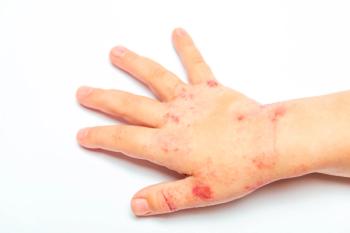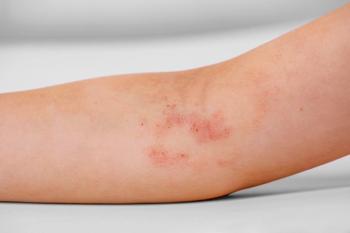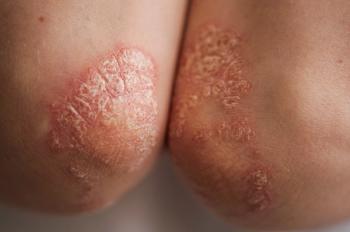
Can you guess the diagnosis?
A 16-month-old with recurrent otitis media developed a spreading unilateral rash on her hip and thigh during antibiotic treatment. PCR testing confirmed herpes zoster, an uncommon diagnosis in young, vaccinated children.
A 16-month-old in generally good health with up-to-date vaccines presented in May with complaints of fussiness and earache. On examination, she was found to have bilateral otitis media and was prescribed amoxicillin. One month later, she presented with similar symptoms and was again diagnosed with bilateral otitis media and prescribed amoxicillin. The patient’s mother phoned the office to report a rash on day 2 of the second course of amoxicillin and added that she learned recently of the maternal grandmother’s penicillin allergy. Amoxicillin was discontinued, cefdinir was started in its place to treat the ear infections, and loratadine was added to help calm the rash. Photos were sent electronically through the electronic medical record (Figure 1).
The following day, her mother called the office to report that the rash was worsening. What began at the right hip (overlying a known hemangioma) now extended to the ipsilateral anterior thigh (Figure 2). Oral corticosteroids were added to her regimen. The following day, she returned to the office to have the rash evaluated in person. On examination, she had islands of erythematous, lichenified skin with scabs dotting the lesions of different stages and shapes, some looking a bit like target lesions (Figures 3 and 4). Her ear examination findings were normal, so cefdinir was discontinued, as were the oral corticosteroids and antihistamines, which did not appear to have any added value associated with their use. After 2 days, the patient again returned to the office with concerns for advancement of the rash. At this visit, her skin had pustules sitting amid the erythematous macules (Figure 5). There were no vesicles or crusting lesions. There were no complaints of pain or tingling. There was no evidence of itching or excoriation. One lesion was unroofed, and a sample was sent for polymerase chain reaction (PCR) testing. What is this child’s diagnosis?
PCR testing of the lesion was positive for varicella-zoster virus DNA, confirming the diagnosis of herpes zoster (shingles).
Drug allergy, erythema multiforme minor, Gianotti-Crosti syndrome, herpes zoster
Condition
Key features
How it differs from herpes zoster
Drug allergy
Urticaria or maculopapular lesions, trunk distribution, often responds favorably to removal of triggering medication.
Rash is truncal and lesions vary in appearance. Rarely blisters, crusting. May have systemic symptoms. Responds to corticosteroids and antihistamines.
Erythema multiforme minor
Target lesions of the skin (not mucous membranes).
No blisters, not painful, can follow medication or illness. Improves with time and antihistamines.
Gianotti-Crosti syndrome
Symmetric eruption of maculopapules, often postviral.
Bilateral distribution, can follow a viral illness such as Epstein-Barr virus (EBV) infection; lesions are not painful.
Herpes zoster
Itchy, blistering, painful rash that follows a dermatome unilaterally. Can be seen in high stress or immunocompromise. Can be exacerbated by corticosteroid use.
Cutaneous drug allergies, also known as morbilliform or maculopapular cutaneous drug eruptions (MDEs), are the most common type of hypersensitivity reaction to β-lactam antibiotics (such as amoxicillin).1 These rashes can cause raised urticaria, patchy macular eruptions, or tiny papular lesions. The appearance can vary greatly, as can the distribution, although these are often concentrated centrally on the trunk. The presence of a concurrent viral infection can increase the likelihood of a patient developing an MDE after a course of antibiotics.2 Removal of the offending medication (frequently an antibiotic in children) will often begin the process of resolution; however, these reactions can remain static for weeks after the drug is discontinued.1
Gianotti-Crosti syndrome (also known as papular acrodermatitis) is a symmetric maculopapular eruption that can follow a viral illness such as Epstein-Barr virus (EBV) infection. Most commonly, it is seen in very young children, mostly younger than 5 years. Its lesions tend to cause itching, and it resolves without the need for intervention, at most after 2 months. This type of rash is often associated with viral illnesses (such as hepatitis A virus and EBV), and in some cases has statistically clustered adjacent to viral outbreaks.3
Erythema multiforme (EM) can be considered an adverse drug reaction; however, its trigger is more often viral. The lesions of EM tend to look like targets or bull’s-eyes, with their hallmark alternating rings of pallor and erythema. EM minor, by definition, does not affect the mucous membranes. In adults, EM is attributed to a drug reaction in only 10% of cases. This proportion is higher in children, and penicillins are often the named culprit.4
Herpes zoster (shingles) occurs when varicella-zoster virus (VZV), the virus that causes chickenpox, is reactivated in the sensory ganglia.5 Patients can get shingles after infection with or immunization against VZV. The lesions erupt unilaterally along a dermatomal pattern, typically starting as erythematous papules that evolve into groups of vesicles that then become pustular and crust over in 7 to 10 days. The visible rash is usually preceded by a painful or unpleasant tingling sensation in that same area. Oral corticosteroids are not typically used to treat shingles, as they can exacerbate the rash.
Shingles is often associated with a decline in cell-mediated immunity, a process typically seen in older adults or in individuals with compromised immune systems. The incidence of herpes zoster rises sharply after age 50 years.6 It is unusual to see a case of herpes zoster in a young, healthy, partially immunized child without a history of wild-type chickenpox in utero or in the first year of life.5 After the introduction of the varicella vaccine in 1995 and the implementation of the 2-dose vaccine schedule in 2007, the incidence of shingles in children dropped substantially. A population-based study published in 2019 reported a 72% decline in incidence from 2003 to 2014.7 Most childhood cases of shingles are in patients with a history of wild-type varicella infection, but the vaccine contains a live attenuated virus strain that can result in latent infection, which can later reactivate to cause herpes zoster.8 Despite its rarity, physicians must remain vigilant for this condition even in low-risk populations, as herpes zoster can have delayed complications, the most common of which is postherpetic neuralgia, defined as pain persisting or recurring months to years after the rash has resolved.9 In severe cases of shingles, antiviral therapy with acyclovir can be initiated. Antiviral therapy aims to prevent new lesion formation, encourage resolution of cutaneous lesions, and decrease viral shedding. If used, it should be started within 72 hours of rash onset.10 Currently, there is no definitive treatment guideline for herpes zoster in children, likely due to the rarity of this diagnosis and the resulting limited opportunity for pediatric research. Trusted resources such as The Harriet Lane Handbook and the American Academy of Pediatrics’ Red Book provide generalized recommendations aligned with adult regimens that emphasize age- and weight-appropriate dosing and monitoring for children.11,12
This 16-month-old immunocompetent, age-appropriately vaccinated patient had a unilateral lower extremity rash that began after an episode of acute otitis media and a partial course of antibiotics. It did not respond to antihistamines and did not get better—or worse—with several days of oral corticosteroids. Its appearance was not preceded by pain or tingling; it was not pruritic, and it never progressed to pustules. While somewhat atypical in its presentation, PCR testing did confirm herpes zoster in this case, and the patient’s mother was relieved to hear the patient had experienced only a mild case of shingles.