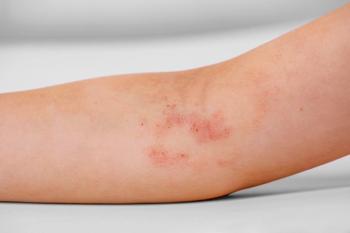
Real-world claims show dupilumab was tied to a 33%-52% lower risk of atopic march progression vs systemic corticosteroids in children with AD.
The sNDA submission follows additional positive topline data that was presented in Janurary 2024, highlighting an open-label, long-term extension study evaluating tapinarof cream, 1%.
Tapinarof cream, 1% (VTAMA; Dermavant Sciences) to treat atopic dermatitis (AD) in adult and children 2 years and older has taken another step forward in the FDA process.1
Dermavant announced in a press release that it has submitted a supplemental New Drug Application (sNDA) to the federal agency for the topical, once-daily, steroid-free aryl hydrocarbon receptor agonist.1
Treatment is intended for both acute and long-term management of AD, which impacts approximately 16.5 million adults and over 9.6 million children in the United States.1
The sNDA submission is supported by positive data from a pair of identical double-blind, randomized, vehicle-controlled
In ADORING 1 and ADORING 2, tapinarof cream 1% achieved statistically significant improvement compared to vehicle in the Validated Investigator Global Assessment for AD (vIGA-AD) scores of 0 or 1 (clear or almost clear) with at least a 2-grade improvement from baseline at week 8 (primary outcome).1
"Greater reductions in the Peak Pruritus-Numeric Rating Scale (PP-NRS) mean scores for [tapinarof] cream versus vehicle were observed as early as Day 1 in ADORING 1 (-1.2 vs -0.9), 24 hours after first application, and Day 2 in ADORING 2 (-1.6 vs -1.4)," said Eric Simpson, MD, MCR, professor, Frances J. Storrs Medical Dermatology, director, CLEAR Eczema Center, Oregon Health & Science University, in a prior
"Itch remains the most burdensome and prevalent symptoms of [AD], and these results highlight the potential of tapinarof as a clinically meaningful therapy with the ability to reduce itch for adults and children living with ]AD]," added Simpson.2
Dermavant states more than 85% of people with AD experience itching daily, and over 67% of patients with AD reported this itch has altered sleep patterns in the past week.1 Over half of children with AD reported that sleep disturbance is one of the most bothersome symptoms of AD.1
In a December 2023
"[Tapinarof] is a whole different mechanism of action," Eichenfield said. "[Dermavant] completed their pediatric studies with that 1% cream down to children age 2 with really really good datasets and can be very, very exciting and that drug's become very popular for psoriasis in adults."3
Tapinarof cream, 1% was approved by the FDA to treat plaque psoriasis in adults on May 24, 2022.1
In the ADORING phase 3 program, data indicated no new safety or tolerability signals of concern in the 2 years and older patient population, and adverse events were "mostly mild to moderate with a low study discontinuation rate due to adverse events," Dermavant stated in the press release.1
According to Dermavant, the most common adverse reactions (≥ 1%) in individuals treated with tapinarof cream, 1% were folliculitis, nasopharyngitis, contact dermatitis, headache, pruritus, and
References:
1. Dermavant submits supplemental New Drug Application (sNDA) to FDA for VTAMA (tapinarof) cream, 1% for the treatment of atopic dermatitis in adults and children 2 years of age and older. Dermavant Sciences. Press release. February 14, 2024. Accessed February 14, 2024. https://www.dermavant.com/dermavant-submits-supplemental-new-drug-application-snda-to-fda-for-vtama/
2. Fitch, J. Tapinarof cream 1% reduces itch as early as 24 hours after application for pediatric AD. Contemporary Pediatrics. October 13, 2024. Accessed February 14, 2024. https://www.contemporarypediatrics.com/view/tapinarof-cream-1-reduces-itch-as-early-as-24-hours-after-application-for-pediatric-ad
3. Fitch, J. Topical steroid and non-steroidal treatments for pediatric atopic dermatitis and potential new agents. Contemporary Pediatrics. December 12, 2024. Accessed February 14, 2024.