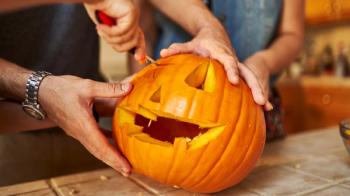
Pumpkin carving accounts for 55% of Halloween ED injuries; AAOS outlines prevention tips for carving, costumes, and trick-or-treating.
Johns Hopkins Children's Center experts outline pedestrian, burn, allergy, anxiety, and candy guidance pediatricians can share before Halloween.
Halloween remains one of the highest-risk nights of the year for young pedestrians, giving pediatricians a narrow window in October to counsel families on that and other seasonal hazards. Experts at Johns Hopkins Children's Center released guidance on October 12, 2026, covering trick-or-treating safety, holiday-related anxiety, candy intake, burn prevention, and food allergy management.¹
Mary Beth Howard, MD, MSc, a pediatric emergency medicine physician at Johns Hopkins Children's Center, pointed to a national increase in pedestrian injuries and deaths around the holiday as a central concern for families planning to trick-or-treat.¹
The best available US data support that concern. In an analysis of 42 years of National Highway Traffic Safety Administration data (1975-2016), investigators identified 608 pedestrian fatalities on Halloween evenings vs 851 across 84 control evenings 1 week before and after, corresponding to a 43% higher relative risk and about 4 additional deaths per Halloween.² Children aged 4 to 8 years faced the steepest increase, with roughly 10-fold higher odds of pedestrian death on Halloween (OR, 10; 95% CI, 5.23-19.11), although the absolute risk remained low.²
Howard recommended costumes that fit well and do not drag on the ground, avoiding swords, canes, and long sticks as props, using face paint rather than vision-limiting masks, and adding reflective tape or glow sticks for visibility.¹ She also advised close supervision of younger children on well-lit routes and reserving pumpkin carving for adults or older teens, with painting as a safer alternative for younger children.¹ The American Academy of Pediatrics (AAP) similarly recommends bright, reflective costumes and testing makeup on a small patch of skin beforehand to screen for reactions.³
Alejandro Garcia, MD, director of the Children's Center Pediatric Burn Program, advised choosing costumes, wigs, and accessories labeled flame resistant or flame retardant; keeping children away from decorations with open flames or hot steam; using battery-operated candles in jack-o'-lanterns; keeping walkways clear; and keeping children at least 3 feet from firepits.¹ For burns, he recommended running the area under cool water for 10 minutes, avoiding ice, oil, ointment, and lotion, covering the wound with a loose, dry, clean cloth, and seeking medical care.¹
Jennifer Dantzer, MD, a pediatric allergist and immunologist, recommended that families read every label and inspect every treat, noting that ingredients can differ depending on a product's size.¹ She advised holding off on eating candy until after trick-or-treating, carrying emergency medication, and trading candy with siblings or swapping it for nonfood treats.¹ For clinicians, October visits are a practical time to confirm that epinephrine prescriptions are current.
Psychologist Joseph McGuire, PhD, suggested introducing the holiday gradually through decorations and age-appropriate books, helping children distinguish real from pretend, choosing funny films over scary ones, and rehearsing trick-or-treating in familiar or less crowded areas.¹ He also urged parents to keep expectations developmentally appropriate for each child.¹
Brandon Smith, MD, a pediatrician and medical director of the Harriet Lane Clinic, recommended setting candy rules before Halloween, emphasizing nonfood activities, serving a healthy meal before trick-or-treating, and handing out alternatives such as glow sticks, stickers, or pencils.¹
The Johns Hopkins recommendations reflect expert opinion rather than new outcome data, and the release does not quantify the benefit of individual measures. The fatality analysis is observational and ends in 2016, so it cannot isolate how much reflective gear or supervision lowers risk.² The study team also called for driver- and community-level action, including slower speeds in residential neighborhoods, alongside parental supervision and street-crossing education.⁴