
We know you love a diagnostic challenge. Can you crack these 6 puzzling cases?
We know you love a diagnostic challenge. Can you crack these 6 puzzling cases?
An 8-year-old girl is admitted to the hospital with complaints of right ear pain, right leg pain, left arm pain, and fever after a week of worsening symptoms.
A 3-week-old female presented to the emergency department with a 3-day history of a progressively enlarging, erythematous, seemingly painful lump on her back.
A 5-month-old Hispanic male presented to the emergency department (ED) at a children’s hospital in the Northeast United States directly from his daycare after caretakers witnessed 2 shaking, seizure-like episodes. The episodes lasted 1 to 2 minutes in the setting of a fever as palpated by the parents.
A 15-year-old female presents to the emergency department of a community hospital with acute onset of duskiness in her left arm.
The father of a healthy 15-year-old girl brings her to the emergency department (ED) for evaluation of blue hands.
A 14-year-old female presents for a wellness visit. On history, she is noted to not have started her menstrual cycle but on physical exam has significant breast and pubic hair development since the age of 10 years.
A 13-year-old boy with poorly controlled type 1 diabetes (T1D) presents to the emergency department (ED) for evaluation of left ear pain and left facial weakness.
A male infant is born and delivery is remarkable for yellow amniotic fluid and a jaundiced infant. Following delivery he is given intensive phototherapy and then develops erythema, which later becomes ecchymosis. What's the diagnosis?
A 16-year-old girl presents to an emergency department (ED) accompanied by her boyfriend to report a 24-hour history of right lower quadrant pain. The pain is associated with midline lower back pain and light vaginal bleeding (1 to 2 tampons per day). She has experienced some nausea but no vomiting.
A 4-month-old girl arrives at the clinic for a well-child visit. Her mother voices concerns about the infant’s poor weight gain, slow feeding habits, and physical delays such as head lag, poor grasp reflex, and rolling over.
After a cesarean delivery at 30 weeks, a 1430-gram premature female neonate was noted to have generalized thick, dark brown scale forming a tight membrane over her entire skin surface. Her mother was a healthy 19-year-old gravida 1 with normal prenatal screening ultrasound and laboratory studies. Family history did not reveal any congenital malformations or genetic disorders.
A 22-month-old African American boy born at 38 weeks by normal vaginal delivery presents to a local hospital from a private pediatric office for failure to thrive. He was seen by his pediatrician until aged 1 month but was lost to follow-up. His delay in walking prompted his mother to reestablish care at age 22 months.
A full-term male infant was born to a 33-year-old gravida 3, para 3 mother. The prenatal course was uncomplicated, without gestational diabetes; the mother received prenatal care at an out-of-state institution. At the delivery, however, the baby was notably macrosomic, with shoulder dystocia and perinatal distress requiring positive pressure ventilation.
A 2-month-old Hispanic girl is transferred by her pediatrician to the emergency department (ED) for evaluation of decreased oral intake, failure to thrive, and large bleeding facial hemangiomas.
A 3-year-old boy presents to the emergency department (ED) with a 1-day history of irritability and listlessness. According to his parents, he was well until the night before when he began to behave abnormally, becoming excessively tired approximately 2 hours after eating dinner. During the night, the boy slept poorly, sporadically awakening with crying followed by brief periods of calmness. The morning of presentation, he was difficult to arouse with intermittent fussiness and reluctance to ambulate.
The mother of a 4-year-old boy, whose family recently emigrated from Haiti, brings him to the pediatric mobile clinic for evaluation of a rash that had begun 11 days earlier as an eruption of vesicular, pruritic papules on the bilateral lower extremities and had spread to the buttocks and medial thighs with sparing of the face. The skin eruption was followed by desquamation of the skin on his palms and soles.
During a routine office visit for mild acute nasal congestion and possible diminished hearing, an isolated, small, pearl-like mass was noted just posterior to the umbo of the left tympanic membrane of a 5-year-old girl.
A previously healthy, 16-year-old Hispanic boy initially presents to the clinic with a 5-day history of tactile fevers, achy malaise, congestion, and a dry cough. He was afebrile with negative rapid strep and monospot tests, but was prescribed fluticasone, benzonatate, and ibuprofen for a presumed upper respiratory infection. He was encouraged to return if symptoms did not improve.
After an otherwise normal pregnancy, a male infant was born at 37 weeks gestational age via emergency cesarean delivery for decreased or absent fetal movement with multiple late and variable heart rate decelerations.
A previously healthy, 16-year-old Guatemalan girl presents to the emergency department (ED) with a 1-month history of dyspnea on exertion.
The anxious parents of a previously healthy 19-month-old boy bring the child to the emergency department for evaluation of progressive rash that began 4 months ago. The skin eruption began as small blisters on his knees, which became tense and ruptured, eventually evolving to red-pink scaly plaques. Over the next few months, the boy developed similar lesions on his hands, elbows, neck, perineal area, and face, with sparing of the mucous membranes.
A 26-day-old female neonate, born at 36 weeks of gestation, presents to the clinic with a visible swelling in the right labia majora.
A previously healthy 8-year-old Hispanic boy presented to the emergency department (ED) with a 2-day history of abdominal pain and 2 episodes of nonprojectile vomiting in the last 24 hours.
The anxious parents of a 9-year-old boy bring him to clinic for the evaluation of progressive sores in his mouth for 2 days and a rash that erupted last night. Nine days earlier, he had felt warm and had a cough with wheezing and abdominal pain.
Two siblings, 5-year-old Emmanuel and 3-year-old Cassandra, are brought to your emergency department (ED) in July 2014 by their parents. Both children are up to date on their immunizations and have not had significant medical problems in the past. They were referred to you by their pediatrician for 1 day of high fevers, rash, and pain in the extremities. Emmanuel had 1 episode of gum bleeding last night. His sister has been unwilling to walk since this morning.
A 9-month-old girl is brought to the emergency department for evaluation after 3 days of poor feeding and 1 day of decreased activity. The day prior to presentation, she was no longer crawling or pulling herself to stand. On the morning of evaluation, she is no longer able to lift her head.
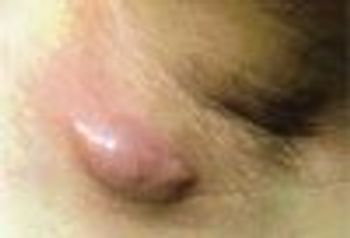
An overweight 13-year-old girl, with a body mass index of 29, presented with a lump in her axilla for the fourth time in the past several months. This time, the lump recurred in the left axilla; it had developed in the right axilla on 2 other occasions.
A 9-year-old girl presented with these lesions on her face and extremities. The lesions, which had developed within the past 24 hours, were warm to the touch and only mildly pruritic. The child feels unwell with nonspecific complaints of malaise and lack of energy. Before this eruption, she had been healthy and had not been taking any medications.