
A 2-year-old boy is experiencing episodes of pallor, perioral cyanosis, and becoming limp after bath time.
A 2-year-old boy is experiencing episodes of pallor, perioral cyanosis, and becoming limp after bath time.
A healthy 2-year-old was noted to have "blueberry" spots on her legs and trunk at birth.
Update on pediatric drug exclusivity legislation and report on how adolescent brain scan images can help prevent drug abuse.
Varicella vaccination update * Goltz syndrome * FDA News * Global News
Pediatric residency training needs more flexible, and more appropriate training. Barriers to these needs include the mechanism by which residency training is funded; the difficulty designing and implementing individualized schedules while maintaining patient services; and the need to design assessments of competence to allow certification of physicians whose training is individualized.
Helpful guidelines for parents when choosing playthings for their child.
While we often think of childhood as a carefree time of life, children and adolescents do in fact experience high levels of stress and anxiety-sometimes on a debilitating scale. For the clinician addressing these issues, recognizing the varying types and causes of anxiety is only half the battle.
A 9-month-old white boy was brought to the emergency department (ED) after he had been crying inconsolably for 2 hours. The parents thought the crying was related to the child's left leg, which they felt "did not look right." Two weeks earlier, the boy had a similar episode of inconsolable crying, and a fracture of the right distal radius was diagnosed. The fracture was presumptively caused by entrapment of his arm in the crib railings.
We frequently see children who have just returned from India with fever, diarrhea, and constitutional symptoms. It is our job to determine whether they have a benign viral illness or something more serious. Some of the children have received malaria prophylaxis (usually mefloquine [Lariam] and occasionally atovaquone and proguanil [Malarone]). The number of children who have been vaccinated against hepatitis A infection is certainly on the rise, but few have been vaccinated against typhoid fever.
It was my first day back at the office after a 2-month medical leave, which included 14 days of hospitalization for severe depression. I'd had plenty of time to ponder whether this was an endogenous or exogenous depression. There were many things that could have caused me to be depressed: the death of my wife a few years ago, a pediatric career devoted-in large part-to abused children, conflicts between the medical school and the hospital, administrative decisions forcing my division to "do more with less" that made life difficult, and a general pervasive attitude that making a profit mattered above anything else.

This 6-month-old infant, born at 29 weeks' gestation, was transferred to Childrens Hospital Los Angeles for evaluation of intermittent stridor and a history of poor feeding.
In his recent case involving a child with a black tongue, John Harrington, MD, noted that certain types of yeast and bacteria produce porphyrins that can give the tongue a black appearance.
A 3-year-oldgirl is brought to the office because of a 1-week history of hematuria and dysuria. Her mother had noticed bright red blood in the child's urine and diaper. The child did not have dysuria initially but later complained of a burning sensation. A week earlier, the patient had been seen at an urgent care center. Oral trimethoprim/sulfamethoxazole was prescribed after urinalysis showed numerous red blood cells and few white blood cells. However, the hematuria persisted.
The National Institute of Child Health and Human Development (NICHD) has announced plans to conduct a large-scale study to determine which of the two most commonly-prescribed medications; diazepam (Valium) or lorazepam (Ativan), is the safer and more effective treatment for children with status epilepticus [more].
Important news and product information from the FDA [more].
ED physicians at UCLA are reminding parents to follow 10 basic rules to prevent drowning and water-immersion injuries this summer [more].
The Centers for Disease Control and Prevention (CDC) has updated and revised its toolkit, “Heads Up: Brain Injury in Your Practice,” to help physicians diagnose and manage mild traumatic brain injury (MTBI) in their patients [more].
The Centers for Disease Control and Prevention’s National Center for Immunization and Respiratory Diseases (NCIRD) recently launched its new vaccines and immunization Web site [more].
The occurrence of seizures in children can generate tremendous levels of anxiety for children, parents, and pediatricians alike. Allaying these concerns and providing the right treatment rests on a systematic approach.
When preemies weighing less than 800 g survive--as more and more of them do--parents want to know what quality of life their child can expect. The answer is that despite the risk of neurodevelopmental disabilities difficulties are rarely severe, resources are available for overcoming problems, and most of these children will live a productive life.
Thyroid problems can be worrisome, but relatively few children referred for workup for an abnormal thyroid test have clinically significant disease. Choosing the right screening tests can prevent these costly encounters without compromising children whose test results warrant close follow-up and possible intervention.
A "rung bell" is common and can do significant acute and long-term harm to a developing brain. Because no guideline or protocol has been adequately studied for application to children and adolescents, take a cautious approach to management of concussion in youth, the author advises.
The new conjugate vaccine MCV4 promises longer duration of immunity and, perhaps, greater clinical efficacy than the polysaccharide vaccine MPSV4. Questions remain about booster doses, vaccinating young children, and safety.
Childhood melanoma is a challenging diagnosis even for a clinician who sees pigmented skin lesions every day. The authors share their international experience with you and describe what you need to know in your practice about the rare, but real, childhood melanoma.
Summertime stings?which actually peak in incidence late in the season?can result in either a mild local reaction and a lesson learned, or a systemic allergic reaction with a devastating outcome. Here are strategies to help you and your patients prevent stings and their potentially devastating outcomes.
Revised guidelines help evaluate the child who doesn't meet all the classic criteria for KD and provide a framework for long-term management based on the risk of myocardial infarction.
How do you deal with "internet-savvy" parents? Dr. Lise Johnson, host of Contemporary Pediatrics Radio discusses the scope of internet information and misinformation with writer Lisette Hilton and practicing pediatrician, Dr. Eileen Costello. Hear about great web resources that are out there and how to make sure your patients share the concerns that web research can often stimulate.
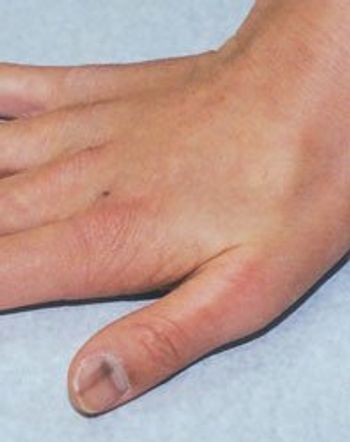
A brown band runs along the longitudinal axis of this teenager’s thumb.