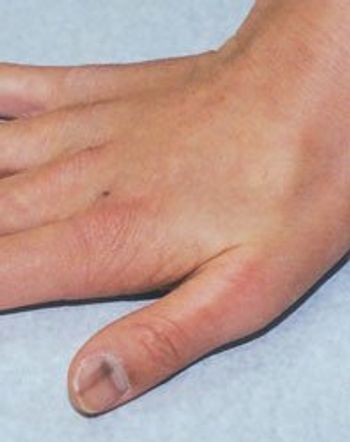
A brown band runs along the longitudinal axis of this teenager’s thumb.
A brown band runs along the longitudinal axis of this teenager’s thumb.

For about a week, a 4-year-old girl had a nonpruritic rash that initially appeared on her legs and arms. Lesions then spread to her face, hands, and buttocks; the trunk was spared. About 2 weeks earlier, the child had had a viral illness that lasted a few days; since then she had been healthy.
A healthy 4-year-old girl presented to the emergency department (ED) with suspected inflicted burns on the tongue. Initially, the patient had complained of a burning mouth to school staff. On direct questioning by the principal, the child said her mother had burned her tongue with a cigarette. School staff noted the lesions.
The parents of a 9-month-old boy were concerned about the bright red color of their son's feces. Over the course of an hour, the infant had 3 bowel movements that appeared to the family to be "more blood than stool." He had no fever or emesis and no history of unusual contacts or travel. There had been no change in his diet; he had not been given any dietary supplements, such as iron.
While playing on a brick walkway in her backyard, a 4-year-old girl stepped on a puss caterpillar and was stung. The ecchymosis exactly outlined the caterpillar's spines and remained visible for at least 3 months. The initial sting caused intense pain that lasted for more than an hour.
Henna and Hair DyeA 16-year-old Somali girl presented with a 30-day history of bilateral arm swelling and painful vesicular eruptions.Five days before presentation, she and her friends had used henna and black hair dye to “tattoo” their skin. Theothers did not experience similar signs or symptoms. This patient had used henna since childhood for decorativepurposes. However, outlining an intricate design with hair dye was new for her.This patient was hospitalized and treated for severe cosmetic dermatitis with systemic corticosteroids,diphenhydramine, and daily dry dressing changes. Ibuprofen was given to help relieve discomfort. Antibioticswere not ordered.The patient remained afebrile and was discharged on hospital day 2 with close follow-up and daily dressingchanges. She was advised to avoid contact with all hair-dye products.Case and photo courtesy of Jennifer A. Jewell, MD, and Lorraine L. McElwain, MD.
For several weeks, this 21/2-year-old boy has had erythematous annular lesions on the lower trunk and proximal lower extremities. He was treated for pityriasis rosea only to have the lesions recur when the topical corticosteroid was discontinued.
ABSTRACT: Most cases of cerebral palsy (CP) are the result of congenital, genetic, inflammatory, anoxic, traumatic, toxic, and metabolic disorders. A minority of cases result from asphyxia at birth. Nearly three-quarters of children with CP aged 7 years had a normal neurological evaluation at birth. Abnormal motor development usually provides the first diagnostic clue. Neuroimaging is recommended if the cause of CP has not been established with perinatal imaging. MRI is preferred to CT. Management of the multisystemic manifestations begins with a comprehensive medical evaluation by a multidisciplinary team that includes family members. Therapy is aimed at maximizing the patient's level of function. Key areas include ambulation, cognitive skills, activities of daily living, hygiene, and rehabilitation into society.
I believe the classification scheme and the biochemical pathways proposed for oligosaccharidoses outlined in a recent case on Hunter syndrome are both misleading and out of date.
According to the American Academy of Pediatrics (AAP), the average child watches 4 hours of television per day.1 By the time a child finishes elementary school, he or she will have seen 8000 murders on TV.1 By high school graduation, that child will have spent more time in front of the TV than in school.2
A 4-year-old Hispanic girl presented with abdominal pain of 2 months' duration that had been increasing in intensity for the past 2 days. The pain was localized to the epigastric area and was associated with episodic nonbilious vomiting and a 4-lb weight loss within the past month. The child had normal bowel movements and no recent travel or change in diet.
Two days after "heading" a soccer ball, a 17-year-old boy presented to the emergency department with progressive pain and a foreign-body sensation in his left eye. Visual acuity was 20/20 in the right eye and 20/25 in the left eye. The pupils were equally round and reactive; full extraocular movements of both eyes were noted. The left eye had conjunctival injection and a 1-mm foreign body on the medial cornea with a surrounding halo of discoloration--typical of a metallic corneal foreign body. A Seidel test (which demonstrates streaming of fluorescein dye from the aqueous humor when illuminated with UV light) revealed no evidence of corneal perforation; there were noareas of fluorescein dye uptake.