





Central Precocious Puberty
Latest News
Advertisement
Latest Videos

Podcasts


Advertisement
More News

Most want to start the conversation, but confidence and timing vary.

In the field of pediatric care, the understanding and management of central precocious puberty (CPP) is evolving, thanks to emerging data and individualized treatment approaches.

The single-arm study has an estimated enrollment of 93 participants, made up of females aged 2 to 8 years and males aged 2 to 9 years with CPP.

In a recent study, increased rates of precocious puberty were observed during the COVID-19 pandemic compared to prior years.

Two experts discuss a variety of subjects on central precocious puberty, including recent study findings that examined treatment initiation and duration with height, the need to individualize treatment decisions for girls with CPP, and 2 case reports.

Karen O. Klein, MD, and Kent L. Reifschneider, MD, discuss a central precocious puberty (CPP) patient case regarding factors that would lead a physician to either stop treating a patient or continue with treatment.

Karen O. Klein, MD, and Kent L. Reifschneider, MD, discuss a central precocious puberty (CPP) patient case regarding factors that would lead a physician to treat a patient.

Karen O. Klein, MD, and Kent L. Reifschneider, MD, discuss individualizing treatment decisions in girls with central precocious puberty (CPP).
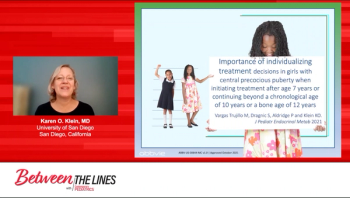
Karen O. Klein, MD, leads a discussion of the Vargas Trujillo et al study on the importance of individualizing treatment decisions in girls with CPP, including factors that influence the decision to begin and cease treatment.
Karen O. Klein, MD, reviews data and study results from the Vargas Trujillo et al study on the importance of individualizing treatment decisions in girls with CPP.
Karen O. Klein, MD, provides an overview of CPP (central precocious puberty) as well as a review of the study design and baseline characteristics from the Vargas Trujillo et al study on the importance of individualizing treatment decisions in girls with CPP.

Puberty is a pivotal development stage that signifies the move from childhood to adulthood. While the timing of puberty can range naturally, the age of onset for puberty in boys and girls has been moving up in recent decades and, for some, this process is triggered entirely too early causing a cascade of short- and long-term consequences.

Central precocious puberty doesn’t just describe adolescents on the early end of the puberty spectrum. This rare condition triggers significantly earlier sexual development—in girls more often than boys—that can cause lifelong symptoms.

For girls with additional body weight, using Tanner staging to determine pubertal development may require more care.

There are a number of reasons a child may show signs of puberty early with many not requiring treatment. However, full initiation of puberty before the normal age range can signal other problems.

The development of adult body odor and axillary hair growth early in life may not always signal that a child is beginning puberty.
Advertisement
Advertisement
Trending on Contemporary Pediatrics
1
Tirzepatide cuts BMI 18.5% in adolescents with obesity
2
US loses measles elimination status; CDC outlines re-elimination plan
3
Semaglutide cuts BMI 13.5% in children aged 6 to 11 with obesity
4
FDA approves adrabetadex for infantile-onset Niemann-Pick type C
5