
This 13-year-old girl, who has just entered secondary school, has been devastated by the appearance of psoriatic plaques on her scalp. She states that her peers shun her and make rude comments about the "scabs" on her face
This 13-year-old girl, who has just entered secondary school, has been devastated by the appearance of psoriatic plaques on her scalp. She states that her peers shun her and make rude comments about the "scabs" on her face
It can be difficult to determine whether unusual, paroxysmal behavior represents a seizure or a nonepileptic event. Children with sudden flailing movements or unresponsive staring may, in fact, be experiencing psychogenic events.
A 13-year-old girl presented to her primary care pediatrician for continuing evaluation of intermittent right lower quadrant and right hip pain of 7 months' duration. As part of the workup, a pediatric orthopedist had ordered an MRI scan of her pelvis. The findings were normal except for the presence of multiple ovarian follicles bilaterally (Figures 1 and 2).
An 11-year-old girl presented with a swelling on the left side of the chin of 1 month's duration; in the past 24 hours, following a bite by an unidentified insect, the swelling had rapidly enlarged and become painful (A). She was otherwise healthy and had no significant medical or family history.
As parents prepare to leave hospitals and physicians' offices with their children, clinicians explain how medications should be administered. Studies have shown that, despite these explanations, medication errors are common in children treated at home. These errors include inaccurate dosing and failure to complete prescribed courses.1
A city's favorite son might have a street named after him. It is common for Broadway theaters to be named for famous actors and actresses. An equivalent distinction for a physician is to have a condition named after him or her. Alexander K. C. Leung, MD, long-time member of the editorial board of CONSULTANT FOR PEDIATRICIANS, recently joined the ranks of those physicians who have been so distinguished. Dr Leung is clinical associate professor of pediatrics at the University of Calgary and pediatric consultant at the Alberta Children's Hospital in Calgary.
I thoroughly enjoyed the articles "Anti-Vaccine Media: Its Impact-and Strategies to Combat It" by Linda Nield, MD, and "Vaccinations: Immunizations Do Not Cause Autism Spectrum Disorder . . . They Prevent Disease" by Golder Wilson, MD, PhD, and Miranda Ramirez, MD (both of which appeared in the Special Issue on Vaccines that accompanied the September 2008 issue of CONSULTANT FOR PEDIATRICIANS).
Numerous brown macules were sparsely distributed over the torso, head, and extremities of an African American newborn. The infant also had a mongolian spot on the buttocks. The baby's mother, a great aunt on the father's side, and the great aunt's daughter and grandson had similar brown macules at birth. All family members were healthy.
The parents of this 5-month-old boy were concerned that his eyes were turned in toward the nose. The infant was otherwise healthy. Physical examination findings were normal. In particular, when a light source was projected onto the eyes, the light reflex was centered in both eyes.
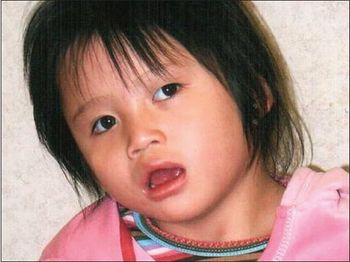
This 4-year-old girl was born to a 27-year-old gravida, 1 para 0 mother at 37 weeks' gestation via vaginal delivery. The pregnancy was uncomplicated. Apgar scores were 8 at 1 minute and 9 at 5 minutes. The child's birth weight, head circumference, and length were 3045 g, 33 cm, and 50 cm, respectively. Her mother noted global developmental delays (particularly in the areas of speech and fine motor skills), abnormal sleep habits, obstructive sleep apnea, and seizure disorder. Family history was unremarkable.