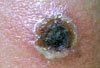

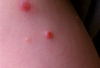


The father of a healthy 3-year-old girl begs you to help with a bleeding bump on her left cheek. It has been present for a few weeks but in the last 2 days has bled profusely on 3 occasions for more than 30 minutes each time.
The father of a healthy 3-year-old girl begs you to help with a bleeding bump on her left cheek. It has been present for a few weeks but in the last 2 days has bled profusely on 3 occasions for more than 30 minutes each time.
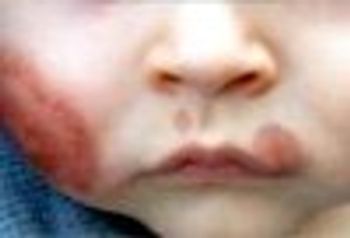
Acute hemorrhagic edema of infancy is a relatively uncommon form of leukocytoclastic vasculitis. Henoch-Schönlein purpura is the primary differential diagnosis.

In this 10 minute video, Dr. Ted Rosen addresses the following questions. A brief synopsis of Dr. Rosen’s comments follows.
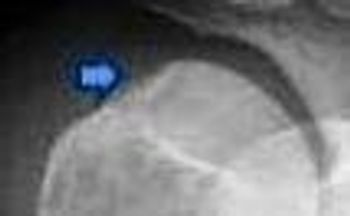
A Hill-Sachs deformity is a compression injury to the posterolateral aspect of the humeral head created by the glenoid rim during dislocation.
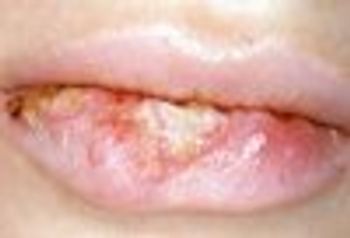
The multiple erosions on this teenager's lip are most likely an exaggerated version of herpes labialis related to his underlying lymphoma. A viral culture would be useful to verify the diagnosis.
The mother of a 4-year-old boy schedules an urgent visit in your office this afternoon for evaluation of a birthmark.

What's your diagnosis? More details here...

These circumferential symmetric skin creases are called the “Michelin Tire baby syndrome” because of their striking resemblance to the mascot of the French tire manufacturer.
The anxious first-time parents of a 10-day-old girl bring the baby to your office for urgent evaluation of a rash on the bottom of her right foot that has persisted despite treatment with topical antibiotics and antifungals.

Diaper Dermatitis is the most common skin problem in infants. The differential includes contact and seborrheic dermatitis, psoriasis, scabies, and infection. Treatment guidelines are outlined here.
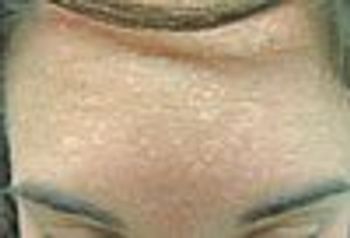
The “rash” of innumerable asymptomatic flat-topped papules on this teenager’s face is highly likely to be flat warts.

Childhood absence epilepsy is distinct from partial epilepsy and is often misdiagnosed as ADD/ADHD. It is one of the most common types of pediatric seizure.
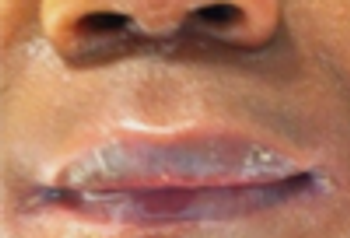
A 5-year-old boy was brought to the emergency department by his parents because of a rash that covered his entire body. The rash had started 2 days earlier, initially on the boy’s face, abdomen, and legs and had spread to his back, buttocks, and hands. There was a 1-day history of tactile fever when the child was sent home from school. He had no sick contacts and his immunizations were up-to-date. He had no significant medical history.
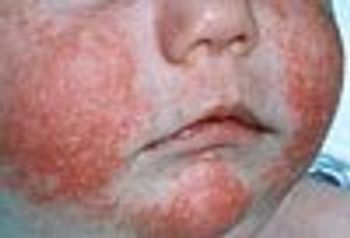
This distribution of an inflammatory disorder in a very young child almost always indicates atopic dermatitis. The family history of asthma suggests the atopic diathesis.
You are called from your office to the nursery to see a healthy newborn with a diffuse facial eruption. Her mother, who had a normal pregnancy, labor, and delivery, has a history of Sjogren's syndrome.
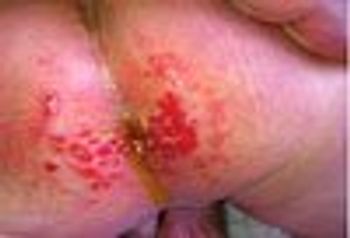
Jacquet’s dermatitis a rare, severe variant of irritant diaper dermatitis, presents with punched-out erosions or ulcerations with crater-like borders.
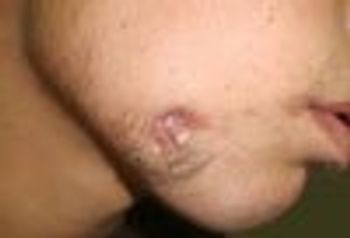
The history and lesional morphology are virtually pathognomonic for a dental sinus. Radiographic examination revealed an apical dental abscess that communicated with the skin via a sinus tract.
What's your diagnosis? More details here...
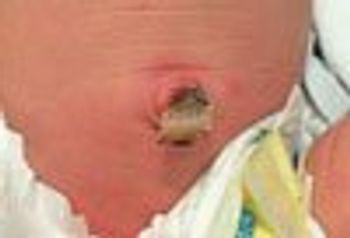
Erythema and periumbilical swelling led to concern about bacterial infection in a neonate.
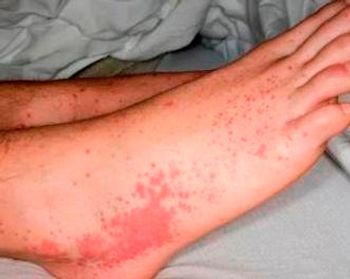
Antibiotic side effect? Diffuse abdominal pain, vomiting, and anorexia led to this initial misdiagnosis in an adolescent male. The full story, here.
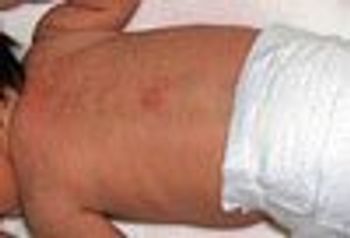
This lump on the back of a neonate was noted shortly after birth and had been expanding. What is it?
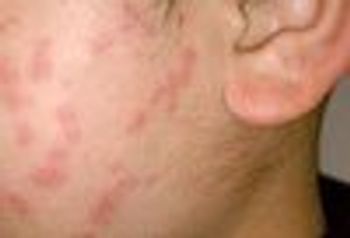
This rash arose a week after a child began to compain of chills, nausea, and a sore throat. What does this look like to you?
This rash arose a week after a 6-year-old boy complained of chills, nausea, and sore throat. WHat's the cause?
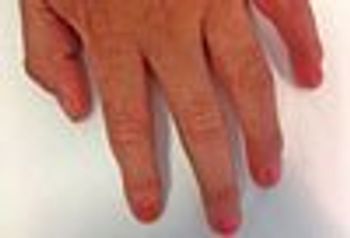
Abnormal pigmentation, nail dystrophy, and leukoplakia may signal dyskeratosis congenita.
The incidence of childhood melanoma is increasing. There is evidence that cumulative exposure to ultraviolet radiation from the sun in the first 18 years of life contributes to the development of future skin cancers.