


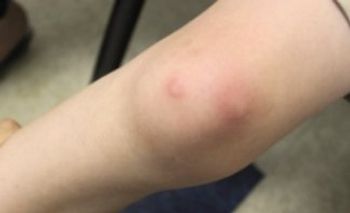
A 5-year old boy presented with these nonpruritic nonsuppurative painful erythematous nodules on his lower extremities. The rash had appeared about 1 week after the onset of a dry hacking cough.
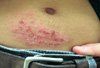
A 5-year old boy presented with these nonpruritic nonsuppurative painful erythematous nodules on his lower extremities. The rash had appeared about 1 week after the onset of a dry hacking cough.
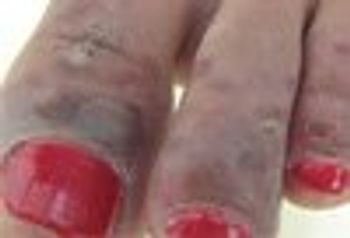
A15-year old girl presented with a rash on both feet that had appeared a month earlier. Initially the rash looked like bruising at the base of both large toenails.

A hypoxemic, 2-month-old boy has respiratory synctial virus bronchiolitis. As you're listening to his wheezing chest during the emergency department visit, his mother asks about the "big freckles" on his scalp and forehead that have been present since birth.

This 7-year-old boy was brought in for a routine well-child visit. His history included profound sensorineural hearing loss, (for which he had received cochlear implants) and congenital heart disease (a small ventricular septal defect, subaortic ridge, right ventricular conduction delay, and mild left ventricular dilatation).

A 4 1/2 year-old Hispanic boy is referred to the pediatric clinic because of failure to thrive and growth retardation. He was born at full-term in Mexico and weighed 1.9 kg at birth (lower than the 3rd percentile).
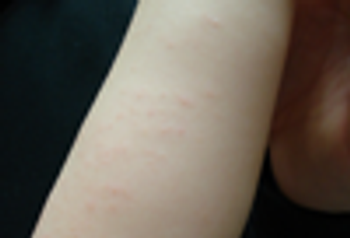
A 3-year old girl presents with a 4-week history of rash on her left arm, flank, and thigh. The rash is non-pruritic and non-painful. The patient is taking no medications and is up-to-date on all immunizations.
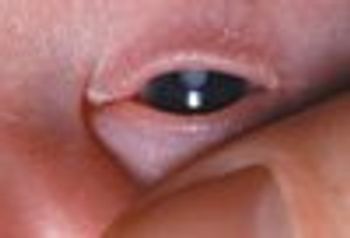
In response to publicity about an alleged but erroneous link between vaccination and autism, the number of children who are being immunized has decreased. This is of concern because many vaccine-preventable diseases have potentially devastating and even lethal consequences.
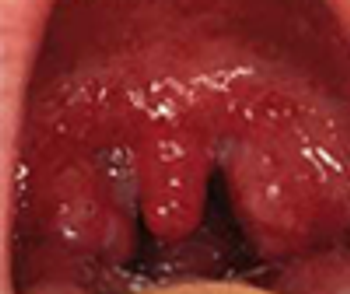
A 2-day history of fever and sore throat and an erupting rash prompted the mother of a 5-year-old boy to bring her son into the office for evaluation.
A study of 125 children who had been placed on elimination diets primarily because of a positive serum immunoglobulin E immunoassay result suggests that the answer tot his question is no.
A healthy 9-month-old boy is brought to the clinic by his mother, who is concerned about multiple golden-brown "bumps" on his trunk, head, arms and legs that developed soon after birth.
Skin Antibiotics - MRSA causes most purulent skin and soft tissue infections in children,antibiotic for skin infections
A 15-year-old boy presents with complaints of a swollen lip on the left side of his face that has lasted for 6 months.
An otherwise healthy 15-year-old boy complains of an increasing number of bumps on his face over the last 3 years.
Imiquimod 3.75% cream has been approved by the FDA for the topical treatment of external genital and perianal warts in patients aged 12 years and older.
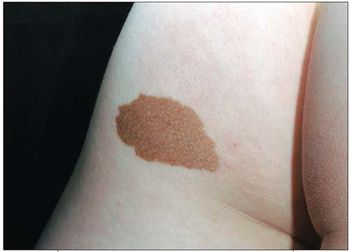
A 12-year-old boy has had this brown patch on his left buttock since birth. His mother is concerned that the patch has grown over the years and she wants to be sure that it will not be a health concern for her son.
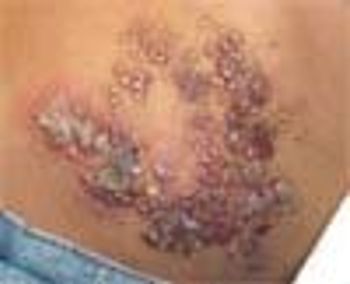
For 3 days, a 6-year-old boy had “redness and pain” of skin on his left upper abdomen. Physical examination revealed a large cluster of vesicles with underlying erythema and mild warmth.

A 4-year-old boy was brought for evaluation of a tiny cystic mass on the penis. The lesion was first noted a year earlier when the foreskin became retractable.

The mass protruding from the introitus of this 1-month-old girl was first noted at birth. She was born to a 26-year-old primigravida at term after an uncomplicated pregnancy and normal spontaneous delivery.

A 6-year-old boy presented with a swollen penis and lip within an hour after ingesting some peanuts.
Pediatricians should be offering advice about ultraviolet radiation (UVR) exposure at 1 or more health-maintenance visits a year, beginning in infancy, according to a new policy statement on UVR recently issued by the American Academy of Pediatrics (AAP).
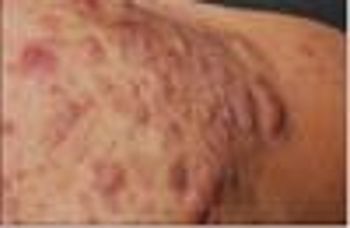
This 16-year-old boy has had severe nodulocystic acne that has responded to isotretinoin therapy. Unfortunately, this therapy was initiated after the scarring process-shown here on the back and shoulder-had developed.
A 10-year-old girl had pain in her left arm after falling off a bunk bed 4 days earlier. She denied fevers or other trauma. Since the fall, she had had difficulty in bearing weight on the arm. Her medical and family histories were unremarkable.
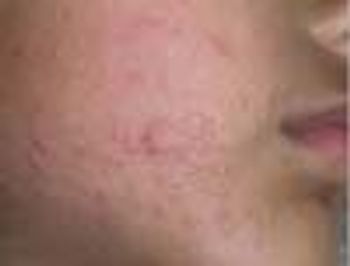
Despite curettage several months earlier, the facial rash on this 4-year-old boy had spread across both cheeks and was now mildly pruritic.
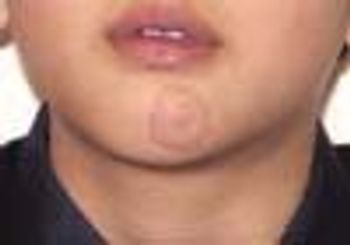
A 7-year-old boy was brought for evaluation of a rash on the chin that had appeared 2 weeks earlier. It was slightly itchy. The mother had applied a topical corticosteroid for a few days but then stopped because of worsening of the lesion.
Pediatricians should be offering advice about ultraviolet radiation exposure at 1 or more health-maintenance visits a year beginning in infancy.