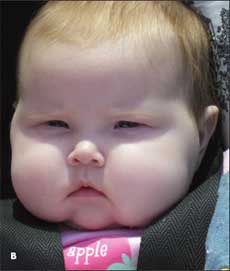
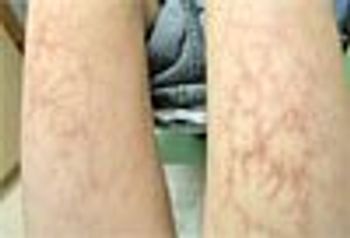
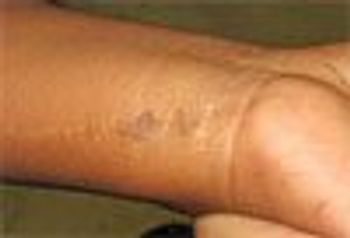
The mother of a 6-week-old infant is concerned about a generalized, scaly eruption evident over the past 10 days.

The mother of a 6-week-old infant is concerned about a generalized, scaly eruption evident over the past 10 days.

Ten-month-old girl with swelling of the left knee of 7 weeks' duration. Unable to bear weight on the left leg for the past 2 weeks. No fever or history of trauma to the area. Infant has good appetite for breast milk and formula, but possible malaise.

This tender lesion on the right cheek of a 4-year-old white girl had appeared shortly after her birth. It had subsequently enlarged for about 3 years before stabilizing. Physical examination revealed an erythematous arcuate plaque with a slightly thickened border that extended from the right oral commissure onto the right cheek. There was no family history of similar lesions, and the child was otherwise healthy.

ABSTRACT: Children who present with rash and fever can be divided into 3 groups: the first group includes those with features of serious illness who require immediate intervention. The second and third groups include those with clearly recognizable viral syndromes and those with early or undifferentiated rash. The morphology of lesions among children with symptoms of serious illness offers clues to the underlying cause. Purpura or ecchymoses in a well-appearing child may not be associated with serious illness; a large percentage of children who present with fever and purpura have Henoch-Schönlein purpura. Kawasaki disease typically manifests with blanching rash and fever. Vesicular or bullous lesions and fever are the hallmark of erythema multiforme, toxic epidermal necrolysis, and staphylococcal scalded skin syndrome. Umbilicated papules and pustules are the sine qua non of molluscum contagiosum and varicella.

Scleroderma may present at any age and can be localized or systemic. Localized scleroderma affects the skin, subcutaneous fascia, and occasionally muscle and bone. Systemic scleroderma is characterized by chronic disease with both skin changes and visceral abnormalities. Rarely, localized scleroderma may progress to systemic disease; however, screening for this form is unnecessary in patients who have no systemic symptoms.1-5

Results of a complete blood cell count (CBC), measurements of electrolyte concentrations, and urinalysis were normal. A rapid streptococcal test result was negative. The C-reactive protein level was elevated at 3.3 mg/L (normal, less than 1 mg/L); the erythrocyte sedimentation rate was 58 mm/h (normal, 4 to 20 mm/h).

Vital signs were normal. Soft tissue swelling of the left foot and ankle was nonsignificant; there was no obvious deformity. Point tenderness was marked over the medial malleolus and over the shaft of the fifth metatarsal distally. The remaining physical findings were normal.

Children who present with rash and fever can be divided into 3 groups: the first group includes those with features of serious illness who require immediate intervention. The second and third groups include those with clearly recognizable viral syndromes, and those with early or undifferentiated rash.

A rock-hard lump on a boy's left great toe that has caused progressive nail distortion and previously diagnosed as a keloid may need a new diagnosis.

In children, most causes ofitching are the result of skin disease,not underlying systemic illness. The mostcommon dermatological causes of pruritusare atopic and contact dermatitis,urticaria, miliaria rubra, infections, insectbites or infestations, xerosis, and aquagenicpruritus. A careful history andphysical examination usually reveal thediagnosis. The location, chronicity, timeof occurrence, and nature of the itchingoffer important diagnostic clues, as doprecipitating factors, associated symptoms,drug use, exposure to infectious diseasesor pets, psychosocial history, past health,and family history. Treatment of the underlyingcause of itching should beaddressed whenever possible. Symptomatictreatment is essential to breakthe itch-scratch cycle.

This teenager had been taking penicillin for a sore throat about 2 weeks before this rash developed. Her pediatrician thought that the rash was a drug reaction and had her discontinue the medication. Nevertheless, the rash persisted for more than a month after therapy was stopped.

Ultrasonography showed a large multiseptated cystic mass in the posterior part of the left side of the neck. No obvious vascular flow evident within the mass (Figures 3 and 4).

The patient had an episode of mild nausea, emesis, and diarrhea 6 days earlier that had resolved. Her mother reported that since then, the child had been lethargic, sleepy, and generally "not herself." The child's appetite had markedly decreased and her skin was cold and pale.

On close inspection, the base of the triangular, seemingly asymptomatic lesion (shown here with the infant lying on her belly) was anterior to the anus on the perineal median raphe. The lesion was excised in the office using local anesthesia, and the opening was sutured with 3.0 chromic catgut. The area was cleaned with warm water until it healed several days later.

Children who present withrash and fever can be roughly dividedinto 3 groups: the first group includesthose with features of serious illnesswho require immediate intervention.

An anxious mother asks you to evaluate two slowly growing asymptomatic nodules on the third and fourth fingers of her healthy 4-month-old son.

This boy has had areas of hypopigmentation around his eyes, mouth, and nose for the past 2 years. He has been applying a topical corticosteroid to the affected area, but new lesions continue to develop.

IP is a rare X-linked dominant disorder. About 700 to 1000 cases have been reported worldwide (about 1 in 50,000 live births); white infants are most commonly affected. In a review of 653 patients, more than half had a family history of the condition.1 Our patient's mother was also affected. IP usually appears within the first 2 weeks of life. The severity and expression of the disorder are highly variable, even among patients within the same family.1,3 The condition is characterized by anomalies of the organs and tissues derived from the ectoderm and mesoderm and may affect the skin, hair, nails, teeth, eyes, and CNS1,2:

This self-limited unilateral dermatitis of unknown cause usually affects preschool children.1-3 Girls are 2 to 3 times more frequently affected than boys.4 The eruption consists of flat-topped pink or flesh-colored papules with a fine scale that form a linear band of less than 1.2 cm in width. It often follows the lines of Blaschko and may extend the entire length of an extremity.

ABSTRACT: Children who present withrash and fever can be roughly dividedinto 3 groups: the first group includesthose with features of serious illnesswho require immediate intervention. Thesecond and third groups include thosewith clearly recognizable viral syndromes,and those with early or undifferentiatedrash. Here the focus is on those childrenin group 1 who have petechiae or purpura.The morphology of lesions amongchildren with symptoms of serious illnessoffers clues to the underlying cause.For example, petechiae may herald suchlife-threatening disorders as meningococcemia,Rocky Mountain spotted fever,and hemolytic uremic syndrome.

Prominent ear deformity is relatively common; this defect- inherited as an autosomal dominant trait-affects approximately 5% of white children.1 As such, surgical correction is a common operation performed by plastic surgeons.

This 20-month-old child has had a localized red mass on the right eyelid that had been present for a few weeks.

Seventeen-month-old Hispanic boy with 7-month history of a swelling on his back. Lesion first looked like a small "scar," then gradually grew over next few months. Lesion appeared to blister, with subsequent discharge of clear fluid. No symptoms other than intermittent pruritus at lesion site. Patient not taking any medications.

Diagnosis and treatment of congenital midline cervical cleft.

This girl was brought for evaluation of these "bumps" around her eyes. Her parents are concerned that the lesions will interfere with her vision.