

Dermatology

Latest News


In addition to syringohydromelia and meningocele, the MRI of the spine showed a fluid-filled mllerian duct remnant that extended from the base of the bladder to the posterior superior aspect of the prostate gland. The margins of the fluid collection in the remnant are smoothly bound by a hypointense structure that represents a discrete tissue wall. A mllerian duct remnant can be confused with free fluid in the cul-de-sac posterior to the bladder.

A 4-year-old boy was brought to the hospital because of fever (temperature of 39.4°C [103°F]) and a bright, salmon-pink rash on the palms and soles that was associated with peeling (A and B). His symptoms had been present for 2 days. During that time, he also had redness of the eyes, fatigue, and anorexia.

There is increasing evidence that the inflammatory nature of psoriasis is associated with an increase in comorbid conditions, such as obesity and cardiovascular disease, and that people with psoriasis have a shortened life expectancy.

Hemangiomas are the most common tumors seen in infants. Despite their rapid growth early in life, often the only action required of the physician is to reassure the parents that such tumors usually involute spontaneously during childhood.

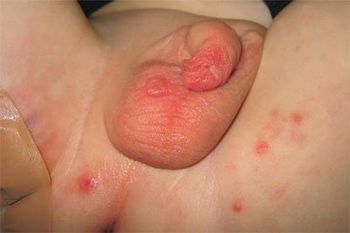
A 7-month-old male infant was brought to the emergency department (ED) by his biological mother, who reported noticing dried blood on the baby's penis and in his mouth. For several hours prior, he had been in the care of her boyfriend. On physical examination, there were severe ecchymoses and petechiae on the penile glans and shaft (Figure 1), ecchymoses on the right side of the soft palate, a laceration of the lingular frenulum, and a 2-cm bruise with dried blood over the right lip.

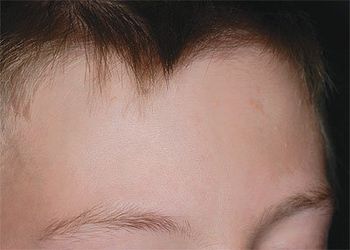
A healthy 16-year-old presents with a raised, two-year-old scar-like lesion on his scalp which has caused hair loss.

An overview of disorders related to allergic symptoms in the pediatric patient, such as rhinitis, otitis media, asthma, and atopic dermatitis, as well as guidence regarding when to refer to an allergist.

This fairly common phenomenon, also known as Mongolian spots, affects more than 90% of African Americans, 80% of Asians, 46% of Hispanics, and fewer than 10% of Caucasians.1 The bluish gray or slate-colored areas occur most frequently on the lower back and buttocks and less frequently on the posterior thighs, legs, back, and shoulders. The face is rarely affected. The skin coloration is believed to be caused by melanocyte migration arrest from the neural crest to the epidermis.

African American girl born at 36 weeks' gestation to 24-year-old primigravida via spontaneous vaginal delivery at a community hospital. Apgar scores, 7 at 1 minute and 9 at 5 minutes. Grossly normal placenta, with a 3-vessel cord. On the second day of life, infant required several minutes of blow-by oxygen for a desaturation event and subsequent transfer to a level III neonatal ICU for further monitoring.

A previously healthy 14-year-old girl presented with retrosternal chest pain, odynophagia, and dysphagia of 10 days' duration. Her medical history was unremarkable. Results of an ECG and a chest radiograph were normal. An upper GI series revealed an abnormality at the level of the mid esophagus. She was treated with lansoprazole and sucralfate for a week; however, her symptoms persisted and perhaps worsened slightly. She lost 2.3 kg (5 lb) during her illness and was referred to a pediatric gastroenterologist.

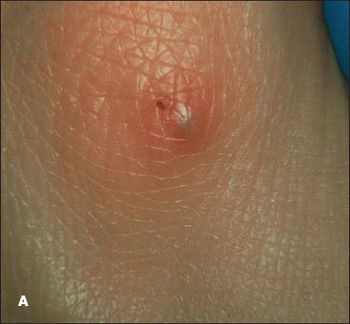
An infected insect bite was initially diagnosed, and a course of oral trimethoprim/sulfamethoxazole was started. Eight days later, the patient returned with worsening symptoms and a "white thing poking in and out" of one of the lesions (A). He was advised to occlude the lesion with petroleum jelly and an adhesive bandage. The next day, the patient brought in the "creature" that had emerged from the lesion. It was subsequently identified as a larva of the human botfly, Dermatobia hominis. A second larva emerged from the other lesion 1 week later.

ABSTRACT: Practicing pediatricians make many clinical decisions each day in the courseof patient care. For each decision, risks and benefits must be weighed. It is important,therefore, to be able to understand different measures of increased or decreased risk.It is also important to be able to talk with patients and their parents about risk. Thisreview of various ways of expressing risk is offered with the goal of making it easierfor pediatricians to incorporate measures of risk into clinical decision making.

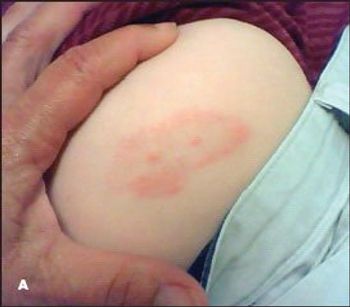
The parents of an 8-year-old boy seek evaluation of a red patch on their son's shoulder. The asymptomatic spot erupted 2 weeks earlier. The patient has seasonal allergies and frequently plays with his dog.